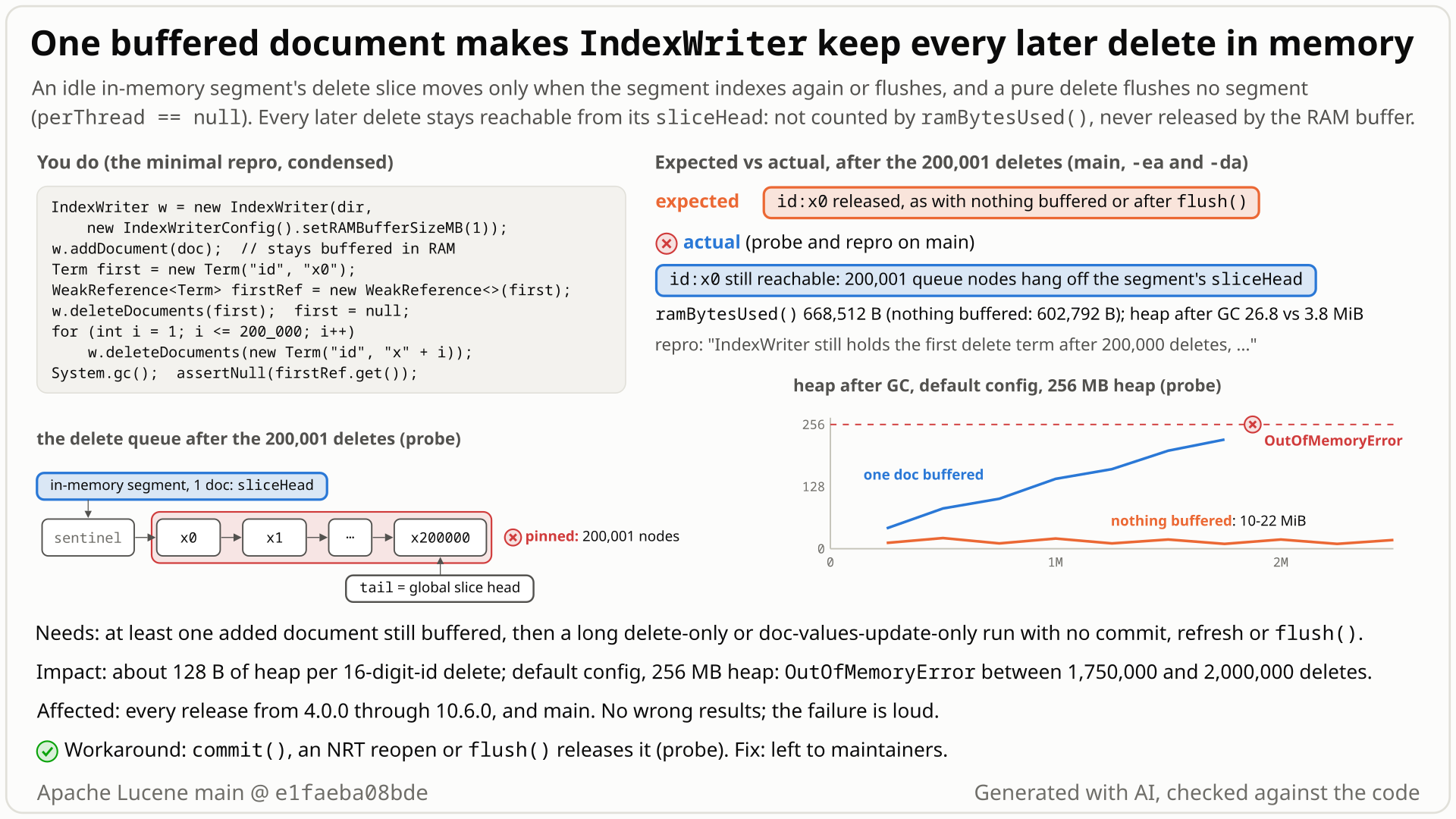
Each in-memory segment keeps a pointer into the writer's shared delete queue, a linked list of every delete. The pointer moves only when that segment indexes another document or flushes. Deletes alone never flush it, so everything after the pointer stays on the heap, and nothing counts it.
IndexWriterbuffers new documents in in-memory segments, one per indexing thread, and writes a segment to disk when the RAM buffer fills (setRAMBufferSizeMB, 16 MB by default) or oncommit(), an NRT reopen orflush().- Deletes and doc-values updates by term go into one shared queue. A buffered segment must apply the deletes that arrive after its documents when it flushes, so it remembers where the queue ended when its last document finished.
- When the buffered deletes reach the RAM buffer, the writer pushes them: it applies them to the segments already on disk and drops its own copy.
- Open an
IndexWriterwith the default config (16 MB RAM buffer) and add one document. Do not commit. - Call
deleteDocuments(new Term("id", id))2.5 million times with new 16-character ids, in a 256 MB heap. - You expect the heap to stay near the RAM buffer: without that one document the same stream stays at 10-22 MiB, because every 16 MB of buffered deletes is applied and dropped.
- Instead the heap grows from 42 MiB at 250,000 deletes to 224 MiB at 1.75 million, then
OutOfMemoryError.ramBytesUsed()says 5.6-14.2 MiB the whole time. - Why: the segment holding the document keeps a pointer into the writer's linked list of deletes, and everything after it stays reachable. The pointer moves only when that segment indexes again or flushes, and deletes alone never flush it.
Default config, one thread, public API. It hits a writer with a buffered document that then runs a long delete-only or doc-values-update-only stretch, such as a bulk purge or backfill, with no commit, refresh or flush(): about 8-10 million 16-byte-id deletes per GB of heap. It ends in OutOfMemoryError, not wrong results.
Mechanism, terms and numbers763 words
Every in-memory segment of an IndexWriter (a DocumentsWriterPerThread, DWPT) keeps a private DeleteSlice: a pointer into the writer's shared delete queue, a singly linked list of every delete and doc-values update. The pointer moves only when the segment indexes another document or is flushed. After one addDocument, a stream of only deleteDocuments(Term) or doc-values updates therefore keeps every later queue node, with its Term or update, strongly reachable.
The RAM buffer never frees them. A pure delete reaches the flush policy with no per-thread writer, so FlushByRamOrCountsPolicy can only push the global delete buffer, which frees the writer's own copy but not the chain behind the idle segment's pointer, and IndexWriter.ramBytesUsed() counts only that global buffer (reset at every push) plus the segments' own bytes. With the default config and 16-character ids the heap grows about 127 bytes per delete until OutOfMemoryError (256 MB heap: 42 MiB at 250,000 deletes, 224 MiB at 1.75 million) while ramBytesUsed() stays at 5.6-14.2 MiB; with no buffered document the same stream stays at 10-22 MiB. updateNumericDocValue and updateSortedNumericDocValue behave the same way.
Keeping these deletes until the segment flushes is required (its document must see them); the defect is that the kept span is unbounded, uncounted and never released by the RAM buffer. It came with per-thread writers in 4.0.0-ALPHA (3.6.2 flushes the document with the deletes) and is in every release up to 10.6.0 and main. commit(), an NRT reopen or flush() releases it.
- DWPT:
DocumentsWriterPerThread, one in-memory segment.numRamDocs()counts the documents buffered in all of them. - Delete queue:
DocumentsWriterDeleteQueue, a singly linked list of nodes, each holding aTerm[],Query[]orDocValuesUpdate[]. The class javadoc: "the garbage collector takes care of pruning the list for us. All nodes in the list that are still relevant should be either directly or indirectly referenced by one of the DWPT's private DeleteSlice or by the global BufferedUpdates slice" (DocumentsWriterDeleteQueue.java:42-45ate1faeba08bde). - Delete slice:
DeleteSlice(DocumentsWriterDeleteQueue.java:333-372), a head and a tail pointer into the queue. Each DWPT has one (DocumentsWriterPerThread.java:134,:165); the global buffer has another. - Push:
DocumentsWriter.applyAllDeletesfreezes the global buffer into a packet that is applied to the on-disk segments, and clears it (DocumentsWriter.java:168-186,DocumentsWriterDeleteQueue.java:262-277).
- After a document is added,
finishDocumentsmoves the DWPT's slice so thatsliceHeadis the queue's tail at that moment: the queue node before the first later delete (in the diagram probe, the sentinel) (DocumentsWriterPerThread.java:361-390). Only this andprepareFlushat flush time (:427-439) move a live DWPT's slice. - Each
deleteDocuments(Term)appends a node and advances only the global slice (DocumentsWriterDeleteQueue.java:129-139,:198-215). ThroughNode.next(:411-412) the idle DWPT's head references every later node. DocumentsWriter.applyDeleteOrUpdate(DocumentsWriter.java:153-165) callsflushControl.doOnDelete(), which passes no DWPT (DocumentsWriterFlushControl.java:497-501). InFlushByRamOrCountsPolicy.onChangeevery branch that marks a segment for flushing needs one, so onlyflushDeletesruns (FlushByRamOrCountsPolicy.java:40-57).- The push frees the global copy only.
DocumentsWriterDeleteQueue.ramBytesUsed()is the global buffer (:557-560), reset at each push, andIndexWriter.ramBytesUsed()is that plus the DWPTs' own bytes (DocumentsWriterFlushControl.java:508-516,IndexWriter.java:795-799). None of these counts the chain, and no delete or update call flushes the idle segment;flush(),commit(), an NRT reopen,flushNextBuffer()or a later document in that segment move its slice. A later document does not free the span:finishDocumentscopies it into the segment's own, counted pending deletes (DocumentsWriterPerThread.java:380-383,:718-722).
The same path serves deleteDocuments(Query...), updateNumericDocValue, updateBinaryDocValue, updateSortedNumericDocValue and updateDocValues(Term, Field...) (IndexWriter.java:1864-2075); the exception is a deleteDocuments(Query...) call with an exact MatchAllDocsQuery, which becomes deleteAll() (:1886-1890) and drops the buffered document too. Executed: Term deletes, numeric and sorted-numeric updates.
| deletes | heap after GC, one buffered document | ramBytesUsed() | heap after GC, no document |
|---|---|---|---|
| 250,000 | 42 MiB | 7.1 MiB | 12 MiB |
| 500,000 | 83 MiB | 14.2 MiB | 22 MiB |
| 1,000,000 | 144 MiB | 13.8 MiB | 21 MiB |
| 1,750,000 | 224 MiB | 5.6 MiB | 10 MiB |
| 2,500,000 | OutOfMemoryError after 1.75M | - | 18 MiB, completes |
One buffered document on e1faeba08bde; the no-document column is the independent reproducer's control on 645d4fe14a20 (same fix-site code apart from #16867's global cap). These are measurements of this workload (OpenJDK 25.0.3, ByteBuffersDirectory, ids String.format("%016d", i)), not an allocation contract. updateNumericDocValue with one document: 51 to 253 MiB over 250,000 to 1.5 million updates, then OutOfMemoryError, ramBytesUsed() at most 13.9 MiB.
Exposure and likelihood260 words
- Who is hit. Applications whose
IndexWriterstill holds at least one added document in RAM and then sends only deletes or doc-values updates for a long time withoutcommit(), an NRT reopen orflush(): a bulk purge by id, a doc-values backfill, a tombstone replay. A buffered document is the normal state right after indexing. - Default vs opt-in. Default
IndexWriterConfig; nothing to opt into. One thread is enough. - Scale. About 110-130 bytes of heap per 16-byte-id delete (127 in the probe), so roughly 8-10 million such calls per GB of heap. The growth is linear and
ramBytesUsed()stays under the buffer, so an application that watchesramBytesUsed()(as theflushNextBufferjavadoc suggests,IndexWriter.java:3745-3757) cannot see it. - How it ends.
OutOfMemoryError, in application code or inside a writer call; in the latter case the writer treats it as tragic and closes, and uncommitted changes may be lost. No wrong results and no damage to the committed index. - Why it is rare. Applications that refresh or commit periodically release the span each time, and nobody has reported it since 4.0 (2012). Workaround:
flush(),commit()or a refresh every few hundred thousand deletes or updates. - Not claimed. When the idle segment finally flushes it copies the whole pinned stream into its private buffer; at 2 GiB of delete terms that throws an "integer overflow"
ArithmeticExceptionfromprepareFlush(a separate run with an 8 GB heap). Several idle segments after multi-threaded indexing pin the same nodes (no multiplication) but each copies the stream at flush (code reading only).
One JUnit test on the public API: a 1 MB RAM buffer, one buffered document, a weak reference to the first delete term, 100,000 more term deletes, then System.gc(). One thread, about two seconds; on stock code it fails every run. Remove the addDocument line and it passes.
/*
 * Licensed to the Apache Software Foundation (ASF) under one or more
 * contributor license agreements.  See the NOTICE file distributed with
 * this work for additional information regarding copyright ownership.
 * The ASF licenses this file to You under the Apache License, Version 2.0
 * (the "License"); you may not use this file except in compliance with
 * the License.  You may obtain a copy of the License at
 *
 *     http://www.apache.org/licenses/LICENSE-2.0
 *
 * Unless required by applicable law or agreed to in writing, software
 * distributed under the License is distributed on an "AS IS" BASIS,
 * WITHOUT WARRANTIES OR CONDITIONS OF ANY KIND, either express or implied.
 * See the License for the specific language governing permissions and
 * limitations under the License.
 */
package org.apache.lucene.index;

import java.lang.ref.WeakReference;
import org.apache.lucene.document.Document;
import org.apache.lucene.document.Field;
import org.apache.lucene.document.StringField;
import org.apache.lucene.store.Directory;
import org.apache.lucene.tests.util.LuceneTestCase;

public class TestIdleSegmentPinsAppliedDeletes extends LuceneTestCase {

  // Expected: deletes pushed past the 1 MB RAM buffer are released; actual: one buffered doc keeps them reachable.
  public void testBufferedDocumentPinsPushedDeletes() throws Exception {
    try (Directory dir = newDirectory();
        IndexWriter w = new IndexWriter(dir, new IndexWriterConfig().setRAMBufferSizeMB(1))) {
      Document doc = new Document();
      doc.add(new StringField("id", "buffered", Field.Store.NO));
      w.addDocument(doc);
      Term first = new Term("id", "x0");
      WeakReference<Term> firstRef = new WeakReference<>(first);
      w.deleteDocuments(first);
      first = null;
      for (int i = 1; i <= 100_000; i++) {
        w.deleteDocuments(new Term("id", "x" + i));
      }
      for (int i = 0; i < 10 && firstRef.get() != null; i++) {
        System.gc();
      }
      assertNull("first delete term still reachable after 100,000 deletes", firstRef.get());
    }
  }
}
cd $LUCENE   # an apache/lucene checkout at e1faeba08bde
cp $REPRO/TestIdleSegmentPinsAppliedDeletes.java lucene/core/src/test/org/apache/lucene/index/
./gradlew :lucene:core:test --tests org.apache.lucene.index.TestIdleSegmentPinsAppliedDeletes -Ptests.seed=5EED1077
# control: delete the w.addDocument(doc) line and the test passes
- Expected
- Deletes pushed past the 1 MB buffer are applied and dropped, so the first delete term becomes garbage and the weak reference is cleared.
- Observed
AssertionError: first delete term still reachable after 100,000 deletes expected null, but was:<id:x0>, with assertions on and off.
More files, environment, full output292 words
The smallest input: 100,000 deletes cross the 1 MB buffer at least twice (with the same buffer and ids, the diagram probe sees the first push at delete x44506), one StringField document is the least that leaves a segment buffered, and the weak reference to the first Term is the direct oracle for "still reachable after it was applied". Assertions on and off give the same failure. The same test is the regression test to add with a fix.
- On stock code the weak-reference check fails every time, since the GC never clears a strongly reachable referent; a fixed build passes only if
System.gc()clears the reference (upstream removed a similar test in #12223). For a fix that flushes,assertEquals(0, w.numRamDocs())after the loop is a GC-free alternative assertion. - The comment line is longer than 100 columns, so
./gradlew tidywould reformat it.
| lucene | main e1faeba08bde (12.0.0-SNAPSHOT); the same failure on the 10.6.0, 10.5.2 and 9.12.3 jars |
|---|---|
| jdk | OpenJDK 25.0.3 |
| os | Linux aarch64 |
# gradle, stock e1faeba08bde, seed 5EED1077, assertions on
TestIdleSegmentPinsAppliedDeletes > testBufferedDocumentPinsPushedDeletes FAILED
    java.lang.AssertionError: first delete term still reachable after 100,000 deletes expected null, but was:<id:x0>
        at org.apache.lucene.index.TestIdleSegmentPinsAppliedDeletes.testBufferedDocumentPinsPushedDeletes(TestIdleSegmentPinsAppliedDeletes.java:45)

# standalone JUnit runner, stock e1faeba08bde, assertions on and off: the same AssertionError
# control without addDocument, assertions off, 3 runs: pass
# with the recommended fix, gradle, seed 5EED1077, assertions on and off: TestIdleSegmentPinsAppliedDeletes, tests=1 failures=0

# supporting heap probe (not the repro): default config, -Xmx256m, assertions off, one buffered document; every sample line
mode=doc ops=250000 heapAfterGC=42MiB ramBytesUsed=7.1MiB numRamDocs=1
mode=doc ops=500000 heapAfterGC=83MiB ramBytesUsed=14.2MiB numRamDocs=1
mode=doc ops=750000 heapAfterGC=103MiB ramBytesUsed=6.6MiB numRamDocs=1
mode=doc ops=1000000 heapAfterGC=144MiB ramBytesUsed=13.8MiB numRamDocs=1
mode=doc ops=1250000 heapAfterGC=164MiB ramBytesUsed=6.1MiB numRamDocs=1
mode=doc ops=1500000 heapAfterGC=202MiB ramBytesUsed=13.2MiB numRamDocs=1
mode=doc ops=1750000 heapAfterGC=224MiB ramBytesUsed=5.6MiB numRamDocs=1
Exception in thread "main" java.lang.OutOfMemoryError: Java heap spacesetRAMBufferSizeMB: "the writer will flush whenever buffered documents and deletions use this much RAM". Here they use unbounded, uncounted RAM.- Without the buffered document the same stream stays at 10-22 MiB, and 3.6.2 releases it: a 4.0 regression.
- "Deleted terms won't trigger a segment flush" (IndexWriter javadoc) contrasted the removed delete-count setting with the RAM buffer.
The full argument403 words
- The contract.
LiveIndexWriterConfig.setRAMBufferSizeMB(LiveIndexWriterConfig.java:157-165ate1faeba08bde): "Determines the amount of RAM that may be used for buffering added documents and deletions before they are flushed to the Directory" and "the writer will flush whenever buffered documents and deletions use this much RAM". - No place in the internal accounting.
DocumentsWriterFlushControl.getDeleteBytesUsed(:503-510): "heap bytes currently consumed by buffered deletes/updates that would be freed if we pushed all deletes". So it counts only what a push frees, the global buffer (a push does free it: in the heap proberamBytesUsed()drops from 14.2 to 6.6 MiB between 500,000 and 750,000 deletes). The queue nodes an idle slice keeps are freed by no push, so they are counted nowhere. (Its next sentence excludes "already pushed delete/update packets", the frozen packets, not those nodes.) - The hedges do not cover it. "just an indicator" is explained by concurrent flushes; the "only approximate" note names delete-by-Query only (
LiveIndexWriterConfig.java:167-177). This is Term deletes, one thread, linear growth. The third note (:179-181: "only a subset of the buffered documents are flushed and therefore only parts of the RAM buffer is released") is about which buffered documents a flush writes; here no document is ever flushed, and the pinned span is never part of the counted buffer. - Bounded without the document; released in 3.x. The no-document control stays at 10-22 MiB and the minimal test without its
addDocumentpasses. In 3.1.0 and 3.6.2 the same workload flushes the buffered document together with the deletes and frees them. - Precedents fixed as bugs. LUCENE-1717 (#2791, uncounted pending-delete RAM: "it's a trap, now. We shouldn't set traps."), LUCENE-3222 (delete-term undercount), LUCENE-3340 (#4413, buffered deletes not flushed by RAM, called a memory leak, its tests "fail on trunk and pass on 3.x"), LUCENE-9478 (#10517, "DWPTDeleteQueue leaks memory", a delete-queue retention leak by another mechanism) and LUCENE-9298 (#10338, RAM accounting in
BufferedUpdateswhen deleted doc IDs and terms are cleared). - Design discussion. On #3647 (LUCENE-2573, 2011) McCandless wrote that the flush policy "needs access to the 'global' deletes count (and also the to [sic] per-DWPT deletes count). If a given DWPT has 0 buffered docs, then indeed the buffered deletes in its pool doesn't matter". Here it has one.
- No test asserts the retention.
TestIndexWriterDelete.testIndexingThenDeleting,testFlushPushedDeletesByRAMandtestApplyDeletesOnFlushnever leave an idle buffered document; thenumRamDocs() > 0asserts ofTestPerSegmentDeletesare in a commented-out block (:102-158).
The devil's-advocate check246 words
The strongest case for "intended" (all the reviews from another model family rated it moderate; the devil's-advocate verifier called the javadoc sentence the main risk, with medium confidence on how upstream will receive it): the IndexWriter class javadoc says "In contrast to the other flush options setRAMBufferSizeMB and setMaxBufferedDocs, deleted terms won't trigger a segment flush" (IndexWriter.java:129-131); the 4.0 CHANGES entry says "IndexWriter only applies and flushes deletes if the maxBufferedDelTerms limit is reached during indexing. No segment flushes will be triggered due to this setting." (lucene/CHANGES.txt:15781-15783); the dev@ thread "FlushPolicy and maxBufDelTerm" (2013-08-01) accepted that delete pressure does not write a segment; the kept deletes really are needed until the segment flushes; and the RAM limit is "just an indicator".
Why it fails: the javadoc sentence was added in f47c3e82985 (LUCENE-3023, 2011-04-28) right after a sentence about setMaxBufferedDeleteTerms, contrasting that count setting with the RAM buffer; 58105a203a1 (LUCENE-7868, 2017) removed the count sentence and left this one. The CHANGES entry and the 2013 thread are about the same count setting ("due to this setting"), and in that thread McCandless wrote "if RAM usage of the buffered del Term/Query s is too high, then a segment is flushed along with the deletes being applied". Nothing documents unbounded, uncounted retained heap; "needed until the flush" is why the slice exists, not a reason never to flush or count it. The fix does not need a segment flush per delete (see Suggested fix).
Recommended Flush idle in-memory segments when a pure delete or update pushes the global delete buffer
When a pure delete or doc-values update pushes the global delete buffer, flush the in-memory segments that are idle (only those it can tryLock, never one an indexing thread holds). It sits in DocumentsWriter.applyDeleteOrUpdate, so every delete and update call is covered. +45/-1 in two files; the repro passes, and 356 tests of 17 IndexWriter suites pass on two seeds.
private long applyDeleteOrUpdate(ToLongFunction<DocumentsWriterDeleteQueue> function)
    throws IOException {
  final long seqNo = applyDeleteOrUpdateLocked(function); // the old synchronized body
  if (seqNo < 0) { // this call pushed the global delete buffer
    DocumentsWriterPerThread idle;
    while ((idle = flushControl.checkoutIdleWriterWithDocs()) != null) {
      doFlush(idle); // prepareFlush applies and drops the idle slice
    }
  }
  return seqNo;
}
All options and trade-offs4 options · 946 words
Option A was written for this doc and validated through gradle in a scratch worktree of e1faeba08bde (OpenJDK 25.0.3). Option C is the hunt's earlier sketch; B and D were not implemented.
Flush idle in-memory segments when a pure delete or update pushes the global delete buffer (validated by the checks) (recommended)
DocumentsWriter.applyDeleteOrUpdate (DocumentsWriter.java:153-165) keeps its synchronized body as applyDeleteOrUpdateLocked; when that returns a negative sequence number (this call pushed the global buffer, :161-163), it flushes, outside the lock, every DWPT returned by a new DocumentsWriterFlushControl.checkoutIdleWriterWithDocs(). That method takes only DWPTs that have documents, are not flush-pending and can be tryLocked, marks one pending and checks it out, like checkoutLargestNonPendingWriter. The flushed segment is published by the caller's IndexWriter.maybeProcessEvents, which already runs for a negative sequence number (IndexWriter.java:6345-6351). +45/-1 in DocumentsWriter.java and DocumentsWriterFlushControl.java.
private long applyDeleteOrUpdate(ToLongFunction<DocumentsWriterDeleteQueue> function)
    throws IOException {
  final long seqNo = applyDeleteOrUpdateLocked(function); // the old synchronized body
  if (seqNo < 0) { // this call pushed the global delete buffer
    DocumentsWriterPerThread idle;
    while ((idle = flushControl.checkoutIdleWriterWithDocs()) != null) {
      doFlush(idle); // prepareFlush applies and drops the idle slice
    }
  }
  return seqNo;
}
Trade-offs
- Bound. For every idle DWPT the push can lock, the kept span ends at that push, so it stays within about one RAM buffer of deletes. Skipped DWPTs keep theirs: one whose
tryLock()fails (an indexing thread holds it; its slice moves at its next document) or one already flush-pending. Nothing retries them, so a skipped DWPT that then stays idle keeps its span until a later push finds it free. The span is also still uncounted before the first push: in the heap probe the heap reached 83 MiB at 500,000 deletes (16 MB buffer, almost 6 times the counted 14.2 MiB) before the first push released it. - Cost. A delete or update call that pushes may now write segments, so it does flush I/O and can throw what a flush throws, as
addDocumentalready can. The flush runs after the delete is queued and pushed, so an exception from it reaches the caller of a delete that has already taken effect; that needs a decision upstream. Each push flushes each idle DWPT it can lock once, anddoFlushthen also flushes any other DWPT already pending (DocumentsWriter.java:502-580), as the add path does. An idle DWPT's segment holds whatever was buffered when indexing paused; segment sizes and counts were not measured, and no throughput benchmark was run. It happens only when the global delete buffer alone reaches the RAM buffer; with documents being added, the add path'sactiveRam + deletesRamcheck usually flushes first (FlushByRamOrCountsPolicy.java:54-55, by reading). With RAM flushing disabled (DISABLE_AUTO_FLUSH), pushes happen only at #16867's 1945 MB cap, so the fix would act only there (by reading). - Concurrency. A DWPT held by an indexing thread is skipped. A push never happens during a full flush (
DocumentsWriter.java:175-176). If a full flush begins between the push and the checkout,checkoutmarks nothing: it returns null for a DWPT that is not flush-pending, and for one that is it blocks it and returns the next pending flush (DocumentsWriterFlushControl.java:261-280), the same handlingcheckoutLargestNonPendingWriter(:789-810, used byflushNextBuffer()) relies on; the pending flag is re-read under the flush-control lock. No concurrency or full-flush test of this path was run. - Docs. The IndexWriter javadoc sentence "deleted terms won't trigger a segment flush" would need updating.
What the checks validated
- The minimal test fails on stock
e1faeba08bde(gradle, seed 5EED1077) and passes with the fix, assertions on and off (gradle on a copy ofe1faeba08bdewith the diff applied; the JUnit XML namesTestIdleSegmentPinsAppliedDeletes; the fact check's standalone JUnit runs agree). - The independent root-cause reviewer's 3-test class (Term deletes, the no-document control and
updateSortedNumericDocValue, which option C misses) passes with the fix. - 17 closest suites (
TestIndexWriterDelete,TestFlushByRamOrCountsPolicy,TestDocumentsWriterDeleteQueue,TestDocumentsWriterStallControl,TestNumericDocValuesUpdates,TestBinaryDocValuesUpdates,TestMixedDocValuesUpdates,TestIndexWriter,TestIndexWriterExceptions,TestIndexWriterWithThreads,TestIndexWriterReader,TestStressDeletes,TestIndexWriterThreadsToSegments,TestPerSegmentDeletes,TestIndexWriterMaxDocs,TestForceMergeForever,TestSoftDeletesRetentionMergePolicy): 356 tests, 16 skipped, 0 failures, seeds 5EED1077 and C0FFEE77. checkGoogleJavaFormatreports nothing in the two changed files;ecjLintMainpasses.- Heap probe with the fix: Term deletes and
updateNumericDocValueboth complete 2.5 million calls in a 256 MB heap, 5-21 MiB after the first push,numRamDocs()0.
Track the bytes appended to the queue since each DWPT's slice head (for example a running total of the global buffer's bytes at each push, recorded when a slice moves), add it to getDeleteBytesUsed(), and let FlushByRamOrCountsPolicy flush or apply the idle DWPT once it passes the buffer.
Trade-offs
More precise than A: it also bounds the uncounted span before the first push and makes ramBytesUsed() honest. More code on hot paths, and it needs a per-node byte estimate.
while (docWriter.flushOneDWPT()) {} after the push in five IndexWriter delete and update methods.
Trade-offs
Validates the root cause (the minimal test passes with assertions on and off), but misses updateSortedNumericDocValue, and flushOneDWPT takes the largest DWPT with a blocking lock, including ones indexing threads are using; the adjudication's summary of the reviews calls it too blunt (tiny segments).
Say in setRAMBufferSizeMB and the IndexWriter class javadoc that while a document is buffered, every later delete and update is kept until the next flush, commit or refresh, and recommend flush() during long delete-only or update-only runs.
Trade-offs
Cheapest; leaves the trap.
Services that run bulk purges or doc-values backfills through one long-lived writer should refresh, commit or flush() every few hundred thousand operations; a service that refreshes on a schedule already releases the kept deletes each time.
Non-formal. A probe compared retained heap with the RAM buffer during a delete-only stream on the stock jar and saw unbounded growth only when one document was buffered; reading the delete-slice code gave the mechanism. A bounded model-based enumeration of writer operation sequences then matched "kept iff a document is buffered" in all 1,170 runs.
The method in full161 words
Method: non-formal (a measurement first, then code reading; the later bounded enumeration is semi-formal).
- The hunt (2026-11-02) ran a heap-versus-RAM-buffer probe on the stock main jar: default config, one thread,
-Xmx256m, one buffered document, then NdeleteDocuments(Term)orupdateNumericDocValuecalls, sampling heap after GC andramBytesUsed()every N/8 calls, against a control with nothing buffered. The idle run grew toOutOfMemoryError; the control stayed bounded. - A hunt unit read the
DeleteSlicecode for the mechanism and reduced it to one public-API JUnit test. - It then checked the prediction with a bounded model-based enumeration (every sequence of up to 3 of 8 writer operations before a delete or doc-values burst, 1,170 runs, assertions on and off): 380 runs kept the first term, all exactly those with
numRamDocs() > 0when the burst started, 0 mismatches. With its fix sketch as a vacuity control, 0 runs kept it. - Commit-level bisection and version ports traced it to the 4.0 per-thread writer landing.
No prior report found (2026-11-02) in GitHub issues, PRs and commits, open PRs' changed files, the JIRA archive, dev@ and java-user@, downstream projects and the web. #14261, an undiagnosed nightly OOM in a stress test without pure deletes, is not shown to be this bug.
Searches3 searches
Context only: #3647 / LUCENE-2573 (2011 flush-policy design: per-DWPT deletes matter when the DWPT has buffered docs), open #3753 / LUCENE-2679 (per-session delete RAM, 2010), #12572 and #12595 (flushNextBuffer and the global buffer), #16867 (global delete-buffer cap, 2026-10-30), dev@ "FlushPolicy and maxBufDelTerm" (2013, about the count setting). Fixed precedents at other sites: LUCENE-1717, -3222, -3340, -9298, -9478. #14261's trace allocates in prepareFlush -> DeleteSlice.apply, but its workload has no pure deletes.
| Where | When | How | Found |
|---|---|---|---|
| apache/lucene issues, PRs and commits; Elasticsearch, OpenSearch, Solr; dev@, java-user@; JIRA archive; the web | 2026-11-02 | a scripted prior-report search run with 51 queries (220 hits, 0 high) and 29 manual GitHub searches (DeleteSlice, sliceHead, idle DWPT, pure deletes, deleteDocuments OutOfMemoryError, DocValuesUpdatesNode, updateNumericDocValue heap and others), on top of the finder's 102 queries and the independent reproduction's and the intended-behaviour check's searches | no report; nearest #14261 (not shown to be this bug) |
| Open and recent apache/lucene PRs and issues | 2026-11-02 | changed files of 30 open PRs touching IndexWriter or DocumentsWriter files; the 13 PRs updated since 2026-11-01; latest commits to the five fix-site files | none changes DeleteSlice, the idle-segment path or the no-DWPT flush branch; #16867 caps only the global buffer |
| JIRA archive | 2026-11-02 | comments of LUCENE-2956, -3023, -2573, -9304, -3222, -9298, -2324 | design context only |
Introduced with per-thread writers: LUCENE-3023 2a969f828c1 (2011-05-01), found by commit-level bisection, with the mechanism from LUCENE-2956 e95097a7c8d. First released in 4.0.0-ALPHA; 3.6.2 releases the deletes. Fails on every executed release up to 10.6.0 and still on main e1faeba08bde.
Versions tested7 rows
Introduced by 2a969f828c1 "LUCENE-3023: Land DWPT on trunk" (2011-05-01, Subversion trunk r1098427, merge commit; no pull request). Its parent 0528549d178 flushes the buffered document and releases the term; 2a969f828c1 keeps the term with numRamDocs=1, assertions on and off. The per-DWPT DeleteSlice and the "garbage collector takes care of pruning" javadoc came from e95097a7c8d, LUCENE-2956 "Support updateDocument() with DWPTs" (#4030, 2011-04-13); later commits to the slice code are refactors only.
Still reproduces on main. On main e1faeba08bde the fix-site files differ from the hunt's 645d4fe14a20 only by #16867 (2813efa40a3, 2026-10-30), which caps the global delete buffer at 1945 MB (DocumentsWriterFlushControl.java:45-53, checked at FlushByRamOrCountsPolicy.java:35-39) and stalls indexing during a full flush when the cap is reached (DocumentsWriterFlushControl.java:326-329); it does not touch DeleteSlice, the idle segment or ramBytesUsed(), and the minimal test still fails.
| Version or commit | Verdict | Result |
|---|---|---|
main e1faeba08bde | affected | the minimal test fails through gradle and the standalone JUnit runner, assertions on and off; heap probe to OutOfMemoryError |
main 645d4fe14a20 | affected | the finder's, the independent reproducer's and the root-cause review's tests fail, assertions on and off |
| 10.6.0, 10.5.2, 9.12.3 | affected | the JUnit fails on the release jars |
| 8.11.4, 7.7.3, 6.6.6, 5.0.0, 4.10.4, 4.0.0, 4.0.0-ALPHA | affected | a main() port keeps the term; its no-document control releases it |
| 3.6.2, 3.1.0 | not affected | the buffered document is flushed with the deletes (numRamDocs=0) and the term is released |
2a969f828c1 vs its parent 0528549d178 | bisect | the landing keeps the term; its parent releases it |
main e1faeba08bde + fix | fix | the minimal test passes, assertions on and off; heap probe completes 2.5M deletes |
Confirmed by the adjudication (medium confidence, about upstream reception) after an independent reproducer, an intended-behaviour devil's advocate and three executed reviews by another model family (OpenAI GPT-5.6), none dissenting; a credibility audit agreed; re-run on the newest main for this doc, with a fix validated.
Checks and verdicts325 words
Each checker that executed wrote or re-ran a test from the claim; the adjudication re-ran the independent reproducer's test with a new seed, assertions on and off.
| Check | Verdict | What it found |
|---|---|---|
| finder (heap probe, JUnit, model-based enumeration) | reproduced | Its JUnit fails on main (assertions on and off, 10 of 10), 10.6.0, 10.5.2 and 9.12.3; the no-document control passes; 1,170 enumerated runs, 0 prediction mismatches. |
| refute review (OpenAI GPT-5.6) | real, medium | Executed. Its own 2-test class fails under 3 seeds, assertions on and off; its control passes; intended case moderate. |
| intended review (OpenAI GPT-5.6) | real, high | Executed. Term deletes and numeric updates keep the first term while ramBytesUsed() stays under 8 MiB; no-document and commit controls release it; 3.6.2 stays bounded. |
| Independent reproducer | real | Its own test fails on main, 10.6.0, 10.5.2 and 9.12.3, assertions on and off; controls without a document and with flush() pass; heap probes reach OutOfMemoryError for deletes and numeric updates. |
| Root-cause review (OpenAI GPT-5.6) | real, high; sketch incomplete | Traced the same chain; found that the hunt's sketch misses updateSortedNumericDocValue. |
| Intended-behaviour devil's advocate | real | Built the javadoc, CHANGES and dev@ case and traced its origin; ramBytesUsed() is about the same with and without the buffered document (668,512 vs 602,792 bytes). |
| adjudication | confirmed, medium | Re-ran the independent reproduction's test with seed 1A2B3C4D: fails, assertions on and off. Rated a crash (OutOfMemoryError), priority Low, with no security impact. |
| credibility audit | confirmed | The audit confirmed it; a separate re-run of the minimal test fails with assertions on and off, passes with the sketch, and its control passes 5 of 5. |
| this doc | real, fix validated | The minimal test fails on main e1faeba08bde (gradle and the standalone JUnit runner, assertions on and off); the recommended fix passes it (gradle, the JUnit XML names the class), the root-cause reviewer's sorted-numeric test and 356 tests of 17 suites on two seeds. |
The diagram as a still image, generated with AI and checked against the code. It is under 10 MB, the limit for a GitHub attachment.
- PNG 473 KB
Finding record, Lucene and upstream sources, repro files and diagram notes1,962 words
- Registry title
- While a document sits buffered in an idle in-memory segment, IndexWriter keeps every later delete and doc-values update reachable, uncounted by ramBytesUsed() and never released by the RAM buffer, so a delete-only or update-only stream grows the heap until OutOfMemoryError (default config, since 4.0.0)
- Area
- index / IndexWriter delete queue (DeleteSlice of an idle DocumentsWriterPerThread, flush-by-RAM on pure deletes)
- Priority
- Low, rank 287: On the default config of every release since 4.0, a long run of only deletes or doc-values updates while some added document is still buffered keeps every delete reachable, outside the RAM accounting, until OutOfMemoryError. It needs millions of calls per GB of heap with no commit, refresh or flush, so it is rare and Low.
- Impact class
- crash
- Impact note
- Hits an application on the default IndexWriterConfig that, while at least one added document is still buffered in RAM, issues a long delete-only or doc-values-update-only run (deleteDocuments(Term), updateNumericDocValue and the other update calls that take the same path) with no commit, NRT reopen or flush() in between: about 110-130 bytes of heap stay reachable per 16-byte-id delete (heap probes: 42 -> 224 MiB over 250k -> 1.75M deletes, then OutOfMemoryError in a 256 MB heap) while IndexWriter.ramBytesUsed() stays at 5.6-14.2 MiB, so roughly 8-10 million such calls per GB of heap; one thread suffices, applications that refresh or commit periodically release the span each time, and every release since 4.0.0 is affected. A second, bounded trigger (2026-11-02): after a phase in which two threads indexed at once, a single thread's ordinary updateDocument stream is pinned the same way by the second, now idle, in-memory segment (163 MiB retained vs 14 MiB in a control after 1.5M updateDocument calls with ramBytesUsed() at 5.3 MiB, OutOfMemoryError in 256 MB before 2.5M calls, default 16 MB buffer, tiny documents); the window closes at the active segment's first RAM flush or any full flush, so the overshoot is about 110 bytes per call times the calls that fill the RAM buffer: roughly 20-30 times the buffer for documents that take only a few bytes of indexing RAM each, and below the buffer for ordinary documents.
- Summary
- You add a document to an IndexWriter with the default config and then, without a commit, NRT reopen or flush(), send a long stream of deleteDocuments(Term) or doc-values update calls, and expect the heap held by those buffered deletes to stay around the RAM buffer, because the writer applies and drops them each time they reach it, as it does when nothing is buffered. Instead the in-memory segment that holds the one document keeps a pointer into the shared delete queue that moves only when that segment indexes again or is flushed, so every later delete stays reachable after it was applied. IndexWriter.ramBytesUsed() does not count it, nothing flushes that segment, and the heap grows with every call until OutOfMemoryError. The same happens without any delete-only run when two threads indexed at once and then one thread keeps calling updateDocument: the second in-memory segment stays idle and pins every later delete term until the active segment fills the RAM buffer and is flushed.
- Introduced
- 2a969f828c1b65d81f0e630188dd8244694765b9 (trunk landing of per-thread writers, LUCENE-3023 'Land DWPT on trunk', Subversion trunk r1098427, a merge commit by Uwe Schindler; LUCENE-3023 = apache/lucene#4097; svn era, no pull request) [exec: commit-level bisection with lucene-core built from the history clone: the parent 0528549d178 releases the Term and flushes the buffered document, 2a969f828c1 keeps the Term reachable with numRamDocs=1, -ea and -da, controls pass]. The mechanism (DocumentsWriterDeleteQueue with a per-DWPT DeleteSlice whose head an idle writer never advances, and the class javadoc that relies on the GC to prune the list) came from e95097a7c8dfc042c09288717822768c6011f5e8, LUCENE-2956 'Support updateDocument() with DWPTs' (apache/lucene#4030) by Simon Willnauer on the realtime_search branch [read: git blame of DeleteSlice on main; the unfinished branch does not discriminate because its control also fails]. A 4.0 regression relative to 3.x, not a recent one. (2011-05-01 (2a969f828c1, author and commit date 2011-05-01T22:38:33Z, landing on trunk); mechanism e95097a7c8d authored 2011-04-13T09:20:39Z)
- First affected version
- 4.0.0-ALPHA [exec: version-port main() probe on the release jar keeps the first Term reachable, its control releases it]; first GA release 4.0.0 [exec]; not affected: 3.6.2 and every earlier release, which have no per-thread writers [exec on 3.1.0 and 3.6.2: the buffered document is flushed with the deletes (numRamDocs=0) and the Term is released]
- Affected versions
- every release from 4.0.0-ALPHA through 10.6.0 (released 2026-10-29, 4ae946e5a9b) and main 645d4fe14a20 (unreleased 11.0) [exec: the claimed JUnit fails 1 of 1 on main with -ea and -da (finder, 10 of 10 with --iters 10; re-run by the cross-model review and the intended-behaviour check; registration check with seeds 5EED1489 and 5EED1490), on 10.6.0 with -ea and -da, and on 10.5.2 and 9.12.3 with -da; the independent reproduction's own test fails on main, 10.6.0, 10.5.2 and 9.12.3 with -ea and -da (on main also re-run by the adjudication with seed 1A2B3C4D); version-port main() probes fail on 4.0.0-ALPHA, 4.0.0, 4.10.4, 5.0.0, 6.6.6, 7.7.3 and 8.11.4 with their no-buffered-document controls passing]; the releases in between by git tag --contains 2a969f828c1 (124 release tags, plus the 8.8.2-8.11.4 releases of the separate lucene-solr branch_8x) and a log of every later commit that touches the slice code (refactors only, each followed by an executed failing release) [read]. Not new in 10.6 (10.5.2 fails the same test). Not fixed upstream: upstream main e1faeba08bde (2026-11-02) changes the fix-site files only by #16867 (2813efa40a3, author date 2026-10-30), which caps the global delete buffer at 1945 MB and stalls indexing during a full flush; it does not touch DeleteSlice, the idle per-thread writer or ramBytesUsed() [read: diff]. Executed on Linux aarch64 with JDK 25 only. The updateDocument trigger (2026-11-02, -da, 1.5M calls, -Xmx256m, default 16 MB buffer): main e1faeba08bd 163 MiB vs control 14 MiB, 10.6.0 157 vs 8, 9.12.3 157 vs 8, 8.11.4 157 vs 7 [exec]
- Status
- documented (brief, checks and a per-finding doc exist)
- Verification
- Confirmed by AI-run checks: an independent repro, a cross-model review that agreed, an intended-behaviour check, a prior-report search and a skeptical audit; not yet triaged by a person.
- Found by
- non-formal; also reached by code reading
- Upstream and prior reports
- none found (2026-11-02, on top of the finder's two scripted prior-report searches (102 queries), the independent reproduction's and the intended-behaviour check's searches (the intended-behaviour check: 168 hits, none on point) and the adjudication's GitHub searches): a scripted prior-report search with 51 queries (16 GitHub issue/PR, 3 commit, 2 downstream, 20 mailing-list, 4 JIRA, 6 web; 220 hits, 0 high, 6 medium); 29 manual GitHub searches on apache/lucene, Elasticsearch, OpenSearch and Solr (DeleteSlice, sliceHead, delete slice, idle DWPT, pure deletes, applyAllDeletes memory, deleteDocuments OutOfMemoryError, DocValuesUpdatesNode, updateNumericDocValue heap and others); the changed files of 30 open PRs that touch IndexWriter or DocumentsWriter* files (none changes DeleteSlice, the idle-DWPT path or the perThread == null branch); JIRA (LUCENE-2956, -3023, -2573, -9304, -3222, -9298, -2324 comments grepped); lists.apache.org dev@ and java-user@; commits by author date since 2026-09-01 on main, branch_11x, branch_10_6 and branch_10x (only #16581, #16867 and the branch_10x decommission). Refresh (2026-11-02): the 13 apache/lucene PRs updated since 2026-11-01 (#16961, #16960, #16959, #16957, #16904, #16896, #16858, #16853, #16805, #16801, #16700, #16564, #16357) are unrelated, no issue was updated since then, 'DeleteSlice' finds only #14261, and the latest commits to the five fix-site files on upstream main e1faeba08bde are #16867 (author 2026-10-30) and older. Nearest items, none the same bug: #14261 (open, 2025-02-19, 0 comments: a nightly OutOfMemoryError in the multi-threaded soft-update stress test testStressUpdateSameDocumentWithMergeOnCommit whose trace allocates in DocumentsWriterPerThread.prepareFlush -> DeleteSlice.apply; undiagnosed, the reporter suspected merging, and that workload has no pure deletes, so it is not shown to be this bug), #3647 / LUCENE-2573 (2011 design comments on global versus per-DWPT delete accounting), #4413 / LUCENE-3340, #2791 / LUCENE-1717, #4295 / LUCENE-3222, #10338 / LUCENE-9298 and #10517 / LUCENE-9478 (fixed precedents at other sites), open #3753 / LUCENE-2679 (2010 feature request about per-session delete RAM), #12572 and #12595 (flushNextBuffer and the global buffer), #16867 (merged 2026-10-30, global buffer cap), dev@ 2013-08-01 'FlushPolicy and maxBufDelTerm' (delete-count trigger applies deletes without writing a segment; no memory discussion). Refresh for the updateDocument trigger (2026-11-02, read-only): 23 queries over apache/lucene issues, PRs and commits, downstream trackers, the mailing lists and the JIRA archive on idle DWPTs, DocumentsWriterDeleteQueue memory, updateDocument OutOfMemoryError and DeleteSlice: 660 hits, none about this trigger (closest: the LUCENE-2956 design, #14261 discussed above, #13571 a sequence-number assertion); #14483 (the AwaitsFix of #14261's test) is about open file handles.
- Lucene commit tested
- main
e1faeba08bde(2026-11-02): the minimal test through gradle and the standalone JUnit runner, assertions on and off, stock and with the recommended fix; its no-document control; 17 IndexWriter suites (356 tests) with the fix on two seeds; the default-config heap probe stock and with the fix. By the hunt on main645d4fe14a20and release jars 10.6.0, 10.5.2 and 9.12.3 (the JUnit), 4.0.0-ALPHA, 4.0.0, 4.10.4, 5.0.0, 6.6.6, 7.7.3, 8.11.4, 3.1.0 and 3.6.2 (amain()port), and the introducing commit and its parent (bisection).
- Finding record
lucene/core/src/java/org/apache/lucene/index/DocumentsWriterDeleteQueue.java:41-45 (at 645d4fe14a20) (class javadoc: 'the garbage collector takes care of pruning the list'; relevant nodes stay referenced by a DWPT's private DeleteSlice or the global slice), :333-371 (DeleteSlice: sliceHead/sliceTail, apply, reset)lucene/core/src/java/org/apache/lucene/index/DocumentsWriterPerThread.java:134, (at 645d4fe14a20) :165 (deleteSlice = deleteQueue.newSlice()), :361-389 (finishDocuments advances, applies and resets the slice), :427-439 (prepareFlush applies the slice): the only places that move an idle writer's slicelucene/core/src/java/org/apache/lucene/index/FlushByRamOrCountsPolicy.java:34-50 (at 645d4fe14a20) (onChange: with perThread == null only flushDeletes runs; no DWPT is marked flush-pending)lucene/core/src/java/org/apache/lucene/index/DocumentsWriter.java:153-185 (at 645d4fe14a20) (applyDeleteOrUpdate -> flushControl.doOnDelete(); applyAllDeletes freezes only the global buffer)lucene/core/src/java/org/apache/lucene/index/DocumentsWriterFlushControl.java:486-503 (at 645d4fe14a20) (doOnDelete passes null; getDeleteBytesUsed javadoc 'heap bytes currently consumed by buffered deletes/updates that would be freed if we pushed all deletes'; ramBytesUsed = getDeleteBytesUsed() + netBytes())lucene/core/src/java/org/apache/lucene/index/LiveIndexWriterConfig.java:157-178 (at 645d4fe14a20) (setRAMBufferSizeMB: 'the writer will flush whenever buffered documents and deletions use this much RAM'; 'just an indicator' explained by concurrent flushes; the 'only approximate' NOTE names delete-by-Query)lucene/core/src/java/org/apache/lucene/index/IndexWriter.java:131 (at 645d4fe14a20) (class javadoc 'deleted terms won't trigger a segment flush'), :3753 (flushNextBuffer javadoc points to ramBytesUsed() for 'the IndexWriters current memory consumption')lucene/core/src/java/org/apache/lucene/index/DocumentsWriterPerThreadPool.java:115-128 (at e1faeba08bde) (getAndLock: freeList.lockAndPoll, else a new writer), :139-153 (marksAsFreeAndUnlock adds the writer back with weight ramBytesUsed()); ApproximatePriorityQueue.java:45-60 (slot = numberOfLeadingZeros(weight): polls by decreasing log of the weight); DocumentsWriterPerThread.java:361-389 (finishDocuments: the only per-document place an in-memory segment's slice moves)
- The finding in 30 seconds
lucene/core/src/java/org/apache/lucene/index/DocumentsWriterDeleteQueue.java:31-45 (at e1faeba08bde) (class javadoc), :68, :129-139, :198-215, :262-277, :279-293, :333-372, :411-412, :557-560lucene/core/src/java/org/apache/lucene/index/DocumentsWriterPerThread.java:134, (at e1faeba08bde) :165, :361-390 (finishDocuments), :427-439 (prepareFlush)lucene/core/src/java/org/apache/lucene/index/DocumentsWriterPerThread.java:380-383 (at e1faeba08bde) (finishDocuments applies the span into pendingUpdates), :718-722 (ramBytesUsed counts pendingUpdates)lucene/core/src/java/org/apache/lucene/index/DocumentsWriter.java:141-165 (at e1faeba08bde) (applyDeleteOrUpdate), :168-186 (applyAllDeletes), :748-750lucene/core/src/java/org/apache/lucene/index/DocumentsWriterFlushControl.java:497-501 (at e1faeba08bde) (doOnDelete passes null), :503-516 (getDeleteBytesUsed, ramBytesUsed)lucene/core/src/java/org/apache/lucene/index/FlushByRamOrCountsPolicy.java:34-58 (at e1faeba08bde) (onChange)lucene/core/src/java/org/apache/lucene/index/IndexWriter.java:795-799 (at e1faeba08bde) (ramBytesUsed), :1864-1872, :1883, :1962, :1996, :2037, :2070 (entry points)lucene/core/src/java/org/apache/lucene/index/IndexWriter.java:1886-1890 (at e1faeba08bde) (MatchAllDocsQuery -> deleteAll, LUCENE-6379)
- Who is affected
lucene/core/src/java/org/apache/lucene/index/IndexWriter.java:1864-1872 (at e1faeba08bde) (Error -> tragicEvent), :3745-3757 (flushNextBuffer javadoc)
- Why it looks unintended
lucene/core/src/java/org/apache/lucene/index/LiveIndexWriterConfig.java:157-181 (at e1faeba08bde)lucene/core/src/java/org/apache/lucene/index/DocumentsWriterFlushControl.java:503-510 (at e1faeba08bde)lucene/core/src/java/org/apache/lucene/index/IndexWriter.java:122-136 (at e1faeba08bde) (class javadoc, flush paragraph)lucene/CHANGES.txt:15729-15783 (at e1faeba08bde) (LUCENE-2956/2573/2324/2555 entry); :5999 (LUCENE-9298)lucene/core/src/test/org/apache/lucene/index/TestIndexWriterDelete.java:1086, (at e1faeba08bde) :1149, :1200; TestPerSegmentDeletes.java:102-158
- Suggested fix
lucene/core/src/java/org/apache/lucene/index/DocumentsWriter.java:153-165, (at e1faeba08bde) :246-260 (flushOneDWPT), :175-176 (no push during a full flush), :493-500, :502-580 (doFlush loops over nextPendingFlush); DocumentsWriterFlushControl.java:261-280 (checkout), :762-811, :789-810 (checkoutLargestNonPendingWriter); FlushByRamOrCountsPolicy.java:54-55; IndexWriter.java:6345-6351
- History
a Lucene main checkout: git log 2813efa40a3 (#16867); diff of FlushByRamOrCountsPolicy.java and DocumentsWriterFlushControl.java against 645d4fe14a20
- Diagrams
lucene/core/src/java/org/apache/lucene/index/DocumentsWriterDeleteQueue.java:42-45, (at e1faeba08bde) :333-372; DocumentsWriterPerThread.java:361-390
- TestIdleSegmentPinsAppliedDeletes.java (one test, public API):
repro/LFV-1077/TestIdleSegmentPinsAppliedDeletes.java(48 lines)
Made from the code at e1faeba08bde and the executed runs.
assets/LFV-1077/bug.png(473 KB)