The merge keys mix two widths: a document with a value gets its global ordinal as a long, a document without one gets the int sentinel Integer.MAX_VALUE. Once global ordinals reach 2^31 - 1, the sentinel is no longer the largest key.
- With an index sort, every segment is written in sort order. For a
STRINGfield, a segment keeps each distinct value once in a sorted dictionary and numbers it (its segment ordinal); documents are compared by these numbers. - Segment ordinals mean nothing across segments, so a merge builds an
OrdinalMapthat numbers the distinct values of all inputs together: the global ordinals, stored aslong. - Each document gets a
longmerge key, its global ordinal, and the merge interleaves the inputs by these keys. ForSTRING_LAST, a document without a value needs a key above every value.
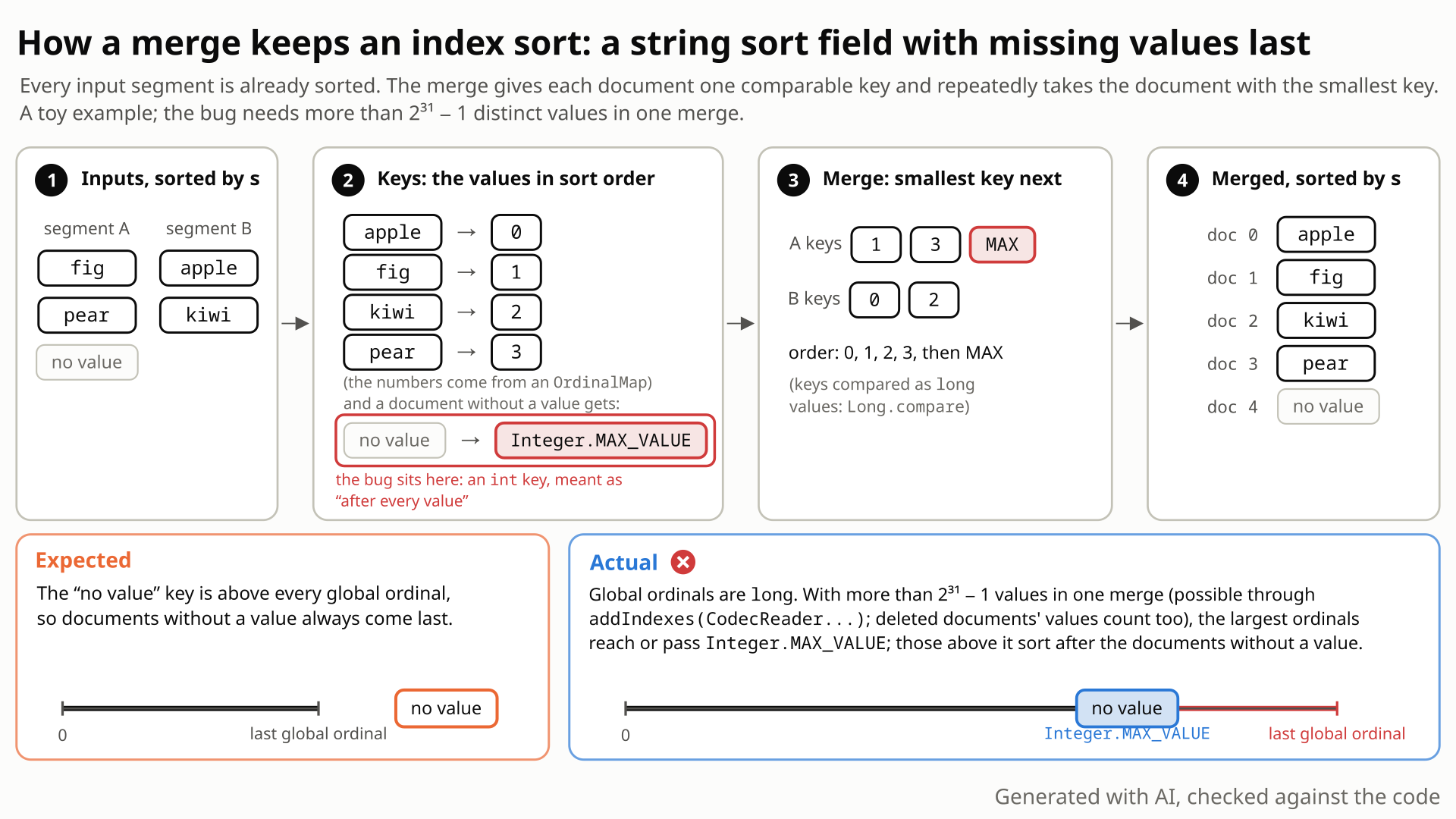
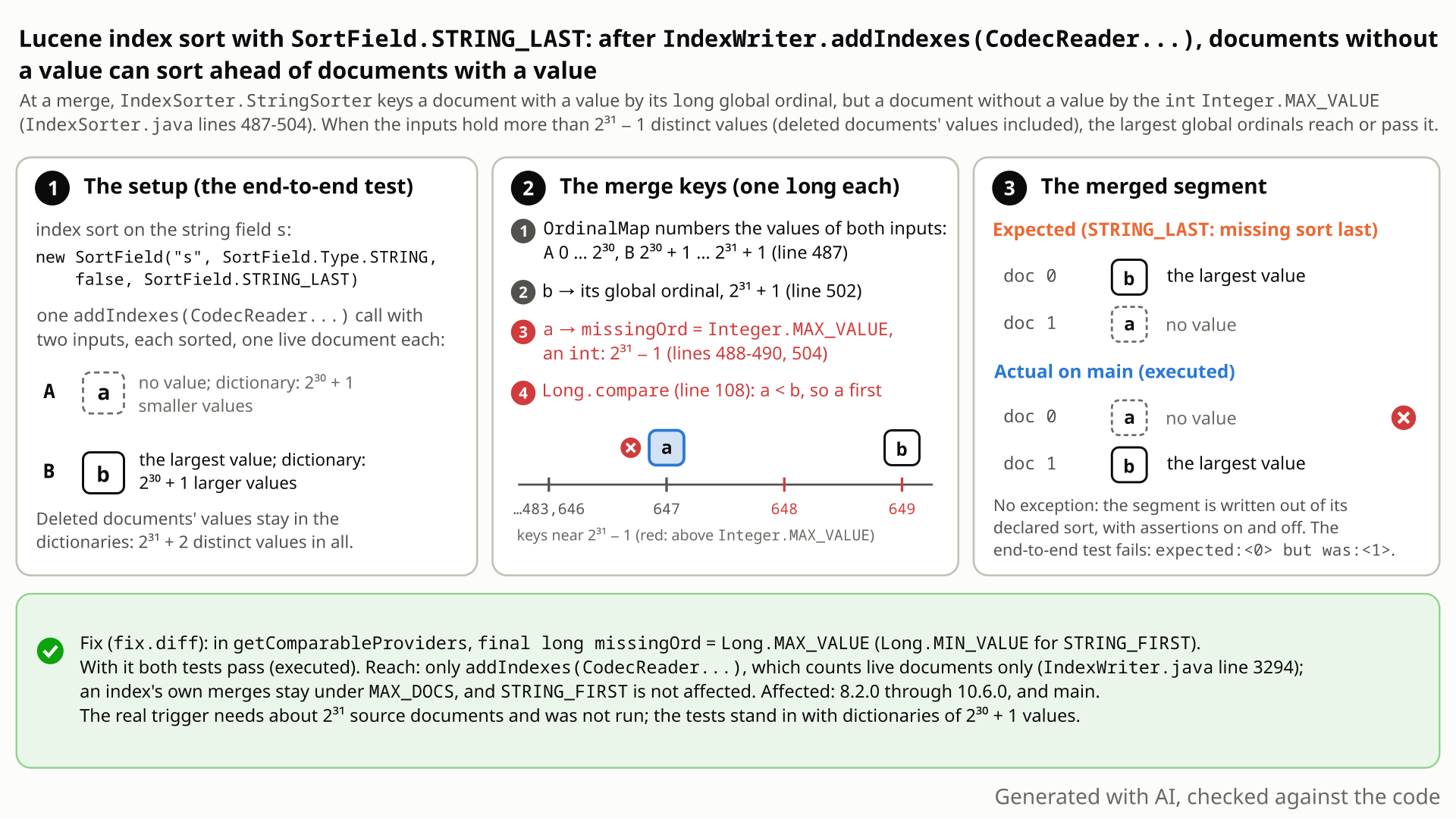
STRING_LAST says last; with reverse=true the largest values would move ahead of it instead. Select the still to open it at full size. Generated with AI, checked against the code.- Sort an index by a string field with documents without a value last:
new SortField("s", SortField.Type.STRING, false, SortField.STRING_LAST). Within one segment this works. - Merge two indexes sorted this way with one
addIndexes(CodecReader...)call. The merge numbers every distinctsvalue of all inputs, counting values that only deleted documents still hold: with 2^30 + 1 values per input, these global ordinals run from 0 to 2,147,483,649. - You expect each document without a value to get a merge key above every value, so it still sorts last.
- Instead its key is the int
Integer.MAX_VALUE, 2,147,483,647, which is below the key of the document with the largest value, 2,147,483,649. The merged segment puts the document without a value first, at doc 0 (this ascending example; withreverse=true, whereSTRING_LASTputs documents without a value first, the same keys move the largest values ahead of them). - No error, with assertions on or off; only
CheckIndexat level 2 or higher notices. An index's own merges never see that many values: it takes about 2^31 source documents.
The route shown to reach it: applications that opt into a STRING_LAST index sort on a STRING field and call addIndexes(CodecReader...) on two or more sorted indexes whose dictionaries, deleted documents' values included, together hold more than 2^31 distinct values while the live total fits under MAX_DOCS. An index's own merges cannot get there; STRING_FIRST is unaffected.
Mechanism, terms and numbers397 words
For an index sort on a STRING field, IndexSorter.StringSorter gives each document a long merge key: its global ordinal from an OrdinalMap over all inputs' dictionaries, or, for a document without a value and STRING_LAST, the int sentinel Integer.MAX_VALUE. Global ordinals are not bounded by the int range, so at 2^31 distinct values in one merge the largest value ties with the sentinel (reader order decides), and with more than 2^31 the largest values get keys above it: the merged segment silently places documents without a value ahead of them (ascending sort; with reverse=true, where STRING_LAST puts documents without a value first, the same keys move the largest values ahead of them), against its declared sort. The in-segment comparator of the same class stays correct, because segment ordinals are ints. The route shown to get there is addIndexes(CodecReader...) over heavily deleted sorted indexes of about 2^31 documents in total; an index's own merges cannot, and STRING_FIRST is not affected. In 7.6.0-8.1.1 the same input threw ArithmeticException (Math.toIntExact, LUCENE-8592); LUCENE-8900 made the keys long in 8.2.0 and dropped that guard. Low priority; the fix is a long sentinel.
getComparableProvidersbuildsOrdinalMap.build(null, values, PackedInts.DEFAULT)over every input'sSortedDocValues, deleted documents' values included (:487);getGlobalOrdsreturnsLongValues(:497).- It sets
final int missingOrd = Integer.MAX_VALUEforSTRING_LAST, elseInteger.MIN_VALUE(:488-493). - A document with a value returns
globalOrds.get(readerValues.ordValue()), along; a document without one returnsmissingOrd, widened to 2,147,483,647 (:498-506). - The keys are cached per reader and compared with
Long.compare(:98-111);MultiSorterorders the merged documents by that comparison (MultiSorter.java:88-97), andMergeState.java:223takes the merge's doc maps fromMultiSorter.sort. - The in-segment
getDocComparator(:512-528) fills anint[]with the same sentinel and int segment ordinals, which always stay belowInteger.MAX_VALUE, so inside one segment the order is right. Only the merge keys disagree with it.
| segment 1 | segment 2 | |
|---|---|---|
| dictionary | 2^30 + 1 terms, global ordinals 0 .. 1,073,741,824 | 2^30 + 1 terms, global ordinals 1,073,741,825 .. 2,147,483,649 |
| live document | no value: key 2,147,483,647 | the largest value: key 2,147,483,649 |
Since 2,147,483,647 < 2,147,483,649, the document without a value is merged first. STRING_FIRST is not affected: Integer.MIN_VALUE is below every global ordinal (all >= 0).
Exposure and likelihood315 words
- How the input is legal.
addIndexes(CodecReader...)reserves only the sum of livenumDocs()(IndexWriter.java:3275-3297);OneMerge(CodecReader...)setstotalMaxDocto that sum (MergePolicy.java:245-255); the defaultfindMerges(CodecReader...)puts all inputs in one merge (MergePolicy.java:616-619); with an index sort the inputs are not wrapped (IndexWriter.java:3548-3566). TheOrdinalMapstill counts values that only deleted documents hold, so heavily deleted sources of about 2^30 documents each can pass 2^31 global ordinals while the merged index fitsMAX_DOCS. A scale model with the document limit lowered to 10 showed exactly this accounting:addIndexes(Directory...)rejected the inputs,addIndexes(CodecReader...)accepted them, and the largest live key, 11, counted the deleted documents' values. - Not reachable otherwise. An index's own merges cannot get there for a single-valued
STRINGsort (its maxDoc is at mostMAX_DOCS< 2^31 - 1).addIndexes(Directory...)(IndexWriter.java:3124-3144), which the bundledIndexMergeTooluses, counts maxDoc and rejects such inputs. The open PR #16847 (long global doc ids) may widen the reach to ordinary merges, depending on its final design. - Effect. Live documents without a value sort ahead of the documents with the largest values (ascending sort; with
reverse=true, whereSTRING_LASTputs documents without a value first, the same keys move the largest values ahead of them); either way the merged segment contradicts its declared sort, and document contents are unchanged.CheckIndexat level 2 or higher reportssegment has indexSort=<string: "s"> missingValue=SortField.STRING_LAST but docID=0 sorts after docID=1; the default level 1 reports the index clean. Code that relies on the index sort, such as early termination on that sort, could return wrong top hits (by reading, not executed). - Default vs opt-in. Opt-in: an index sort,
STRING_LAST, and the expertaddIndexes(CodecReader...)API. Assertions on or off make no difference. - Likelihood: contrived. About 2^31 source documents (an estimate: hundreds of GB) in one call; no public report found since 8.2.0 (2019).
One JUnit test method: two one-document segments whose SortedDocValuesProvider gives each 2^30 + 1 terms, 2^31 + 2 global ordinals in all. It asks StringSorter for its merge keys and checks that the document without a value sorts after the one with the largest value. Deterministic, single thread; needs a 2 GB heap.
/*
 * Licensed to the Apache Software Foundation (ASF) under one or more
 * contributor license agreements.  See the NOTICE file distributed with
 * this work for additional information regarding copyright ownership.
 * The ASF licenses this file to You under the Apache License, Version 2.0
 * (the "License"); you may not use this file except in compliance with
 * the License.  You may obtain a copy of the License at
 *
 *     http://www.apache.org/licenses/LICENSE-2.0
 *
 * Unless required by applicable law or agreed to in writing, software
 * distributed under the License is distributed on an "AS IS" BASIS,
 * WITHOUT WARRANTIES OR CONDITIONS OF ANY KIND, either express or implied.
 * See the License for the specific language governing permissions and
 * limitations under the License.
 */
package org.apache.lucene.index;

import java.util.List;
import org.apache.lucene.document.Document;
import org.apache.lucene.search.SortField;
import org.apache.lucene.store.Directory;
import org.apache.lucene.tests.util.LuceneTestCase;
import org.apache.lucene.util.BytesRef;

public class TestStringSorterMissingLast extends LuceneTestCase {

  public void testMissingKeyAboveGlobalOrdsPastIntRange() throws Exception {
    try (Directory dir = newDirectory()) {
      try (IndexWriter w =
          new IndexWriter(dir, new IndexWriterConfig().setMergePolicy(NoMergePolicy.INSTANCE))) {
        w.addDocument(new Document());
        w.commit();
        w.addDocument(new Document());
      }
      try (DirectoryReader r = DirectoryReader.open(dir)) {
        LeafReader a = r.leaves().get(0).reader();
        LeafReader b = r.leaves().get(1).reader();
        int n = (1 << 30) + 1;
        IndexSorter sorter =
            new IndexSorter.StringSorter(
                SortField.Provider.NAME,
                SortField.STRING_LAST,
                false,
                leaf -> leaf == a ? new OneDoc(0, n, -1) : new OneDoc(n, n, n - 1));
        IndexSorter.ComparableProvider[] keys = sorter.getComparableProviders(List.of(a, b));
        long missing = keys[0].getAsComparableLong(0);
        long present = keys[1].getAsComparableLong(0);
        // expected: the missing key sorts after global ord 2^31 + 1; actual: it is
        // Integer.MAX_VALUE
        assertTrue("missing=" + missing + " present=" + present, missing > present);
      }
    }
  }

  private static final class OneDoc extends SortedDocValues {
    private final long first;
    private final int valueCount;
    private final int ord;
    private final BytesRef term = new BytesRef(new byte[8]);
    private int doc = -1;

    OneDoc(long first, int valueCount, int ord) {
      this.first = first;
      this.valueCount = valueCount;
      this.ord = ord;
    }

    @Override
    public BytesRef lookupOrd(int o) {
      long v = first + o;
      for (int i = 7; i >= 0; i--, v >>>= 8) {
        term.bytes[i] = (byte) v;
      }
      return term;
    }

    @Override
    public int getValueCount() {
      return valueCount;
    }

    @Override
    public int ordValue() {
      return ord;
    }

    @Override
    public boolean advanceExact(int target) {
      doc = target;
      return ord >= 0;
    }

    @Override
    public int docID() {
      return doc;
    }

    @Override
    public int nextDoc() {
      return advance(doc + 1);
    }

    @Override
    public int advance(int target) {
      return doc = (target == 0 && ord >= 0) ? 0 : NO_MORE_DOCS;
    }

    @Override
    public long cost() {
      return 1;
    }
  }
}
cp $REPRO/TestStringSorterMissingLast.java $LUCENE/lucene/core/src/test/org/apache/lucene/index/
cd $LUCENE && ./gradlew :lucene:core:test --tests org.apache.lucene.index.TestStringSorterMissingLast -Ptests.seed=DEADBEEF -Ptests.heapsize=2g
# the same failure with -Ptests.asserts=false
- Expected
- The key of the document without a value is above the largest present key, 2,147,483,649.
- Observed
AssertionError: missing=2147483647 present=2147483649, on main with assertions on and off, and on the 10.6.0 jars with assertions off.
More files, environment, full output349 words
TestStringSorterMissingLast (one method, extends LuceneTestCase, package org.apache.lucene.index of the lucene/core tests, ASF header included). It uses only public API: IndexSorter.StringSorter's constructor with SortField.STRING_LAST and a SortedDocValuesProvider. Segment 1's document has no value; segment 2's document holds the largest of the 2^31 + 2 terms. The cost is the OrdinalMap over 2^31 + 2 terms, so the test needs -Ptests.heapsize=2g (the default 512 MB test heap is too small: a run with a 512 MB heap ran out of memory inside OrdinalMap.build). No smaller input can show the bug: it needs at least 2^31 global ordinals (2^31 gives a tie with the missing key, more than 2^31 a strict inversion; the repro uses 2^31 + 2).
The dictionaries are larger than their one-document segments, which IndexWriter never writes itself; they stand in for huge segments whose values mostly belong to deleted documents. The real trigger, about 2^31 source documents in one addIndexes(CodecReader...) call, was not run. An end-to-end variant that runs the real addIndexes(CodecReader...) merge over two sorted segments (each a deleted document with a value and a live document, dictionaries enlarged to 2^30 + 1 terms by a FilterCodecReader) fails on main, 10.6.0, 10.5.2 and 9.12.3 with STRING_LAST: the document with a value must be doc 0 expected:<0> but was:<1>, and passes with 2^10 + 1 terms; it is supporting evidence, not the repro.
As a regression test the same method fits in TestIndexSorting next to testMissingStringLast. With the fix in place, the file passes checkGoogleJavaFormat; it differs from the first executed copy only by one comment wrapped onto two lines, as the formatter asked, and fails the same way. Through gradle the test takes about 3 minutes (its test JVMs run with -XX:TieredStopAtLevel=1 -XX:ActiveProcessorCount=1), about 80 s with a plain JUnit launcher.
| lucene | main 5adff78bb168 (12.0.0-SNAPSHOT) and 10.6.0: fails |
|---|---|
| jdk | OpenJDK 25.0.3 (build 25.0.3+9-LTS) |
| os | Linux aarch64 (nothing platform-specific) |
TestStringSorterMissingLast > testMissingKeyAboveGlobalOrdsPastIntRange FAILED
    java.lang.AssertionError: missing=2147483647 present=2147483649
        at __randomizedtesting.SeedInfo.seed([DEADBEEF:475E6A8AB947C209]:0)
        at org.junit.Assert.fail(Assert.java:89)
        at org.junit.Assert.assertTrue(Assert.java:42)
        at org.apache.lucene.index.TestStringSorterMissingLast.testMissingKeyAboveGlobalOrdsPastIntRange(TestStringSorterMissingLast.java:51)

# -Ptests.asserts=false: the same failure; 10.6.0 jars, assertions off: the same failureSTRING_LASTpromises "missing string values sort last", andComparableProviderpromises its long keys order documents as the comparator does; neither has a size limit.- In 7.6.0-8.1.1 this input threw
ArithmeticException(Math.toIntExact, LUCENE-8592); LUCENE-8900 made the keys long and dropped the guard without discussion. - The same class's in-segment comparator keeps documents without a value last; only the merge keys disagree.
The full argument183 words
- Contracts.
SortField.java:346: "Pass this as a missingValue constructor parameter to have missing string values sort last."IndexWriterConfig.java:504:setIndexSort, "Set the Sort order to use for all (flushed and merged) segments."IndexSorter.java:57-62:ComparableProvider"Returns a long so that the natural ordering of long values matches the ordering of doc IDs for the given comparator". No javadoc, CHANGES entry or test caps the combined dictionary of a merge. - History. LUCENE-8592 (#9638,
9f29ed0757e, 2018) wrapped the global ordinal inMath.toIntExact, so this input threw (executed on 7.6.0 and 8.1.1). LUCENE-8900 (#9943,17f2f96a5cf, 2019, "Simplify MultiSorter") turned the keys into longs and returned the raw ordinal but kept the int sentinel; its thread mentions neither. - Tests.
TestIndexSorting.testMissingStringLast(TestIndexSorting.java:479) checks the property on small inputs only; no test covers global ordinals past the int range. - Not claimed, not investigated. The
SortedSetSortFieldroute through the same code.SortedSetSelectordocuments "Fields containing Integer.MAX_VALUE or more unique values are unsupported" (SortedSetSelector.java:35); whether that limit, stated for one selector view, also covers the combined dictionary of a merge was not examined.
The devil's-advocate check118 words
Strongest argument: Michael McCandless wrote on #9638 that for single values "it should never happen that the long ord exceeds positive int space"; no Lucene merge or bundled tool reaches 2^31 values; and the repro uses synthetic dictionaries larger than their segments. Why it fails: that sentence is a claim of impossibility, true for an index's own merges, and its consequence was a fail-loud guard that a later refactor removed as a side effect. addIndexes(CodecReader...) legally merges inputs whose dictionaries exceed it, and Lucene itself feeds StringSorter views whose value count exceeds maxDoc (SortedSetSortField.java:184-191, through SortedSetSelector, whose views report the whole multi-valued dictionary, SortedSetSelector.java:156-157). The argument lowers the priority (hence Low), not the intent.
Recommended Use Long.MAX_VALUE / Long.MIN_VALUE as the missing merge key (A, recommended, validated)
Make the missing merge key a long outside the global-ordinal range in StringSorter.getComparableProviders: Long.MAX_VALUE for STRING_LAST, Long.MIN_VALUE for STRING_FIRST. The in-segment int sentinels stay. The repro passes, and so do the 62 TestIndexSorting tests.
      OrdinalMap ordinalMap = OrdinalMap.build(null, values, PackedInts.DEFAULT);
      // global ordinals are longs and may exceed Integer.MAX_VALUE
      final long missingOrd;
      if (missingValue == SortField.STRING_LAST) {
        missingOrd = Long.MAX_VALUE;
      } else {
        missingOrd = Long.MIN_VALUE;
      }
All options and trade-offs3 options · 372 words
Option A was built and checked through gradle on 5adff78bb168; B is an equivalent variant and C a fail-loud alternative, neither run in this form (C is what 7.6.0-8.1.1 did). A and B keep addIndexes(CodecReader...) working on such inputs; C rejects a legal call.
In IndexSorter.StringSorter.getComparableProviders (IndexSorter.java:488-493), declare missingOrd as long and use Long.MAX_VALUE for STRING_LAST, Long.MIN_VALUE otherwise. Global ordinals are >= 0 and below the total value count, so these keys are always outside their range. getDocComparator keeps its int sentinels, which are correct for int segment ordinals.
      OrdinalMap ordinalMap = OrdinalMap.build(null, values, PackedInts.DEFAULT);
      // global ordinals are longs and may exceed Integer.MAX_VALUE
      final long missingOrd;
      if (missingValue == SortField.STRING_LAST) {
        missingOrd = Long.MAX_VALUE;
      } else {
        missingOrd = Long.MIN_VALUE;
      }
Trade-offs
No cost: the key is already a long. The merged order changes only for inputs that hit the bug.
What the checks validated
- Gradle in a scratch worktree at
5adff78bb168, seedDEADBEEF,-Ptests.heapsize=2g: the repro fails without the fix (assertions on and off:missing=2147483647 present=2147483649) and passes with it (assertions off). - With the fix and assertions on: the repro (1) and
TestIndexSorting(62, includingtestMissingStringLastand the other threetestMissing*String*tests): 63 tests, 0 failures, 0 skipped. checkGoogleJavaFormatpasses with the fix and the repro in place.- The end-to-end
addIndexes(CodecReader...)variant passes with the same change shadowed in, and the cross-model reviewers' boundary tests and the four upstreamtestMissing*String*tests passed with it in their own runs.
Set the STRING_LAST key to ordinalMap.getValueCount() and the STRING_FIRST key to -1: one past the largest global ordinal and one below the smallest.
Trade-offs
The same order as A with dense keys; A stays closer to the existing code. Not run.
Narrow the global ordinal with Math.toIntExact, as LUCENE-8592 did, so such a merge throws ArithmeticException instead of writing a mis-sorted segment.
Trade-offs
Loud instead of silent, but a legal addIndexes(CodecReader...) call is then rejected. 7.6.0 and 8.1.1 behave this way (executed); not run on main.
Only an application that itself runs such an addIndexes(CodecReader...) merge can trigger it; a downstream product that relies on early termination over a STRING_LAST index sort could then return wrong top hits from the merged segment (by reading, not executed).
A proof-obligation audit of IndexSorter.StringSorter's contract: its merge keys must order documents as its in-segment comparator does, for every global ordinal an OrdinalMap can return. The obligation fails once global ordinals reach Integer.MAX_VALUE, and a one-method JUnit test on the stock main jars witnessed it.
The method in full130 words
Method: semi-formal (a proof-obligation audit of a class's contract, witnessed by an executable repro).
- The obligation comes from
ComparableProvider(IndexSorter.java:57-62): the long keys must order documents asgetDocComparatordoes. ForStringSorterthe audit compares the key ranges: global ordinals take any value in[0, valueCount)with alongvalueCount, while the missing key is fixed atInteger.MAX_VALUE. The obligation holds only whilevalueCount <= 2^31 - 1, and nothing on theaddIndexes(CodecReader...)path enforces that. - A one-method JUnit test with dictionaries just past that bound witnessed the gap, and the long sentinel made it pass.
- An independent reproducer wrote its own end-to-end
addIndexestest, cross-model reviews and a devil's-advocate verifier tried to refute it, and an adjudication re-ran the tests ("Prior reports, history and checks").
No prior report found (searched 2026-11-02: GitHub issues, PRs and commits incl. the JIRA archive, downstream trackers, four mailing lists, the web and the files of all 408 open PRs; re-checked the same day). Nearest: #9638 (LUCENE-8592, which added the fail-loud guard) and #9943 (LUCENE-8900, which dropped it).
Searches3 searches
No issue, PR, review comment, list thread, JIRA entry or downstream report describes the STRING_LAST missing merge key falling below long global ordinals, and nothing upstream fixes it. Limits: keyword search only; one web query was throttled; private reports are not visible.
| Where | When | How | Found |
|---|---|---|---|
| GitHub issues, PRs and commits (apache/lucene, apache/lucene-solr), JIRA archive, dev@, java-user@, issues@ and commits@ lists, Elasticsearch, OpenSearch, Solr, web | 2026-11-02 | two scripted prior-report searches (52 queries: 1,418 hits, 0 high, 7 medium, all medium read; and 24 list and JIRA queries: 532 hits, the only high one LUCENE-8592) and 43 manual GitHub searches: StringSorter, missingOrd, getComparableProviders, STRING_LAST global ordinal, toIntExact global ordinal, index sort missing ordinal overflow, ... | no report of this defect |
| Open PRs and recent activity | 2026-11-02 | the changed files of all 408 open PRs; full reads of #16847, #16571 and #16851; items created on 2026-11-02 (#16962-#16965); commits on IndexSorter.java and MultiSorter.java; a re-check | none touches IndexSorter.java; #16571, #16847 and #16851 edit MultiSorter.java for other reasons; #16847 (long global doc ids) would widen the reach if it lands |
| Related items (read) | 2026-11-02 | #9638 / LUCENE-8592, #9943 / LUCENE-8900, #16202, #8625 / LUCENE-7574, #11253 / LUCENE-10216 | history only: the guard, its removal, the last change to IndexSorter.java, an older missing-ordinal bug with another cause, and the change that created findMerges(CodecReader...) |
Introduced by LUCENE-8900 "Simplify MultiSorter" (17f2f96a5cf, branch_8x aad4b411cdd, 2019-07-09, #9943), first released in 8.2.0. 7.6.0-8.1.1 throw ArithmeticException on the same input instead (executed on 7.6.0 and 8.1.1; the tags between have the same Math.toIntExact). Every release run from 8.2.0 to 10.6.0, and main, fails; not fixed upstream.
Versions tested11 rows
Before: LUCENE-6766 (2016) introduced the int sentinel; LUCENE-8592 (9f29ed0757e, Jim Ferenczi, 2018, #9638) added Math.toIntExact on the global ordinal, so 7.6.0-8.1.1 fail loudly. 7.0.0-7.5.0 truncate the ordinal with an (int) cast, a different defect (by reading).
Introduced: 17f2f96a5cf on master and aad4b411cdd on branch_8x (Adrien Grand, 2019-07-09; a JIRA patch migrated as #9943). In MultiSorter, return Math.toIntExact(globalOrds.get(readerValues.ordValue())); became return globalOrds.get(readerValues.ordValue()); while missingOrd stayed an int. On the 8.2.0 jars, putting back only the pre-commit MultiSorter.java restores the ArithmeticException, and the commit's file with long sentinels passes. LUCENE-9330 (2020) moved the code unchanged into IndexSorter.StringSorter.
Not fixed upstream: upstream main 1c2072f0284 (2026-11-02) still has the int sentinel; the last commit on IndexSorter.java is e6f12f31d08 (#16202, 2026-06-05). 8.8.2-8.11.3 are inferred, not run.
| Version or commit | Verdict | Result |
|---|---|---|
| 7.5.0 | probe | passes (a different (int)-cast defect, not this bug) |
| 7.6.0, 8.1.1 | probe | ArithmeticException: integer overflow (Math.toIntExact) |
| 8.2.0 | probe | fails: the document without a value merged to doc 0 |
| 8.2.0 + pre-commit MultiSorter.java | bisect | ArithmeticException |
| 8.2.0 + commit with long sentinels | bisect | passes |
| 8.5.2 | probe | fails |
| 8.6.0, 8.11.4, 9.0.0 | affected | fails (equivalent test) |
| 9.12.3, 10.5.2 | affected | fails, assertions off |
| 10.6.0 | affected | fails, assertions off (this repro) |
| main 5adff78bb168 | JUnit, gradle | fails, assertions on and off |
| main with fix A | not affected | passes; the 62 TestIndexSorting tests pass |
The finder's test, an independent reproducer with its own end-to-end addIndexes test, two executed cross-model reviews (OpenAI GPT-5.6: real, high), a devil's-advocate verifier and an adjudication (confirmed, Low, medium confidence: proof-only end to end) all found it real, and a final re-run reproduced it. This doc's gradle runs reproduced it and validated the fix.
Checks and verdicts364 words
The cross-model reviews ran on the older main ea57360912ed, where IndexSorter.java is identical to 5adff78bb168; the intended-lens test was re-run on 5adff78bb168. Every other check ran on 5adff78bb168 or release jars.
| Check | Verdict | What it found |
|---|---|---|
| finder | reproduced | Provider-level test fails on main (assertions on and off), 10.6.0 and 9.12.3 with missing=2147483647 present=2147483649; the long sentinel makes it pass. |
| independent reproducer | real, Low | Own end-to-end test through addIndexes(CodecReader...), written from the claim only, fails on main (assertions on and off), 10.5.2 and 9.12.3; a 2^10 + 1 term control passes; the fix makes it pass; CheckIndex level 2 flags the merged segment, level 1 does not. |
| cross-model review, refute lens (OpenAI GPT-5.6, executed) | real (high) | Own boundary test fails with assertions on and off, a 12-term control passes, both pass with the fix, and TestIndexSorting.testMissingStringLast passes with the fix. Intended argument rated weak. |
| cross-model review, intended lens (OpenAI GPT-5.6, executed) | real (high) | Rejected the works-as-designed case: STRING_LAST and ComparableProvider are unconditional, nothing caps the merged dictionary, and LUCENE-8900 dropped the guard without discussion. Its boundary test fails on 5adff78bb168; the four upstream testMissing*String* tests pass with the fix. |
| devil's-advocate verifier | real, Low | Examined design assumption, documented limits, misuse, unreachability, the synthetic witness and scale; only scale survives, and it bears on priority. Its scale model with the document limit lowered to 10 confirmed the accounting the trigger relies on. |
| adjudication | confirmed, Low, medium | Re-ran the end-to-end test on main with a fresh seed, assertions off: fails. Medium confidence because the full-scale trigger was not run. |
| final re-run and repro check | reproduced | Re-runs on main and 10.6.0 fail, with the fix shadowed in they pass; one deterministic test, legal public-API input, silent result with assertions off. |
| this doc's gradle check | reproduced; fix A validated | Gradle at 5adff78bb168: the repro fails with assertions on and off; with fix A it passes, and with assertions on the repro plus TestIndexSorting run 63 tests with 0 failures; checkGoogleJavaFormat passes with the fix and the (comment-rewrapped) repro. The repro also fails on the 10.6.0 release jars, assertions off. |
The diagram as a still image, generated with AI and checked against the code. It is under 10 MB, the limit for a GitHub attachment.
- PNG 477 KB
Finding record, Lucene and upstream sources, repro files and diagram notes1,702 words
- Registry title
- Index sorting by a STRING field with STRING_LAST: at merge, a document without a value gets the int key Integer.MAX_VALUE while documents with a value get long global ordinals, so when the inputs of one merge hold more than 2^31 - 1 distinct values (reachable through IndexWriter.addIndexes(CodecReader...)), the merged segment silently puts documents without a value ahead of documents with a value
- Area
- index / index sorting at merge: IndexSorter.StringSorter merge keys (MultiSorter), reached through IndexWriter.addIndexes(CodecReader...)
- Priority
- Low, rank 980: A STRING_LAST index sort merged through addIndexes(CodecReader...) silently places documents without a value ahead of the documents with the largest values, against the declared sort, in every release since 8.2.0. It only happens when the inputs of one call hold at least 2^31 distinct sort values, deleted documents included, so it is an extreme-scale, contrived case.
- Impact class
- data corruption
- Impact note
- Hits only applications that opt into an index sort on a STRING field with missing value STRING_LAST and call IndexWriter.addIndexes(CodecReader...) on the leaves of two or more indexes already sorted the same way whose doc-values dictionaries, counting values that only deleted documents still hold, together have at least 2^31 distinct values while the live total fits under MAX_DOCS: the merged segment then silently places live documents without a value ahead of the documents with the largest values, contrary to its declared sort, with -ea and -da; CheckIndex at level 2 or higher reports the violation (the default level 1 does not), and index-sort early termination on that sort could return wrong top hits (by reading, not executed); STRING_FIRST, an index's own merges of a single-valued STRING sort (maxDoc <= MAX_DOCS < 2^31 - 1) and smaller addIndexes calls are not affected, and the full-scale trigger (2^31 or more source documents) was not run (proof-only end to end).
- Summary
- You configure the index sort new SortField("s", SortField.Type.STRING, false, SortField.STRING_LAST) and merge, with IndexWriter.addIndexes(CodecReader...), sorted source indexes whose 's' dictionaries together hold more than 2^31 - 1 distinct values, expecting documents without a value to come after every document with one, as STRING_LAST and the in-segment comparator promise. At merge, IndexSorter.StringSorter gives a document with a value its long global ordinal (from an OrdinalMap over every input's full dictionary, deleted documents' values included) but gives a document without a value the int key Integer.MAX_VALUE, so every value whose global ordinal is above 2^31 - 1 sorts after the missing documents (a value at exactly 2^31 - 1 gets the same key as they do). The merged segment is written out of its declared sort with no error: in an end-to-end addIndexes(CodecReader...) test over two one-live-document segments whose dictionaries a FilterCodecReader enlarges to 2^30 + 1 terms each, the document without a value ends up at doc 0.
- Introduced
- 17f2f96a5cf8e0001a81b9327c2ddced053e6934 on master and its branch_8x copy aad4b411cdd2d517328a2444147b407d4a38343d (the one that shipped first, in 8.2.0), 'LUCENE-8900: Simplify MultiSorter' (a JIRA patch, migrated as apache/lucene#9943, no pull request; by jpountz, +1 from danmuzi). In MultiSorter#getComparableProviders, case STRING, the merge key became a long and 'return Math.toIntExact(globalOrds.get(readerValues.ordValue()))' became 'return globalOrds.get(readerValues.ordValue())', while 'final int missingOrd = Integer.MAX_VALUE' (STRING_LAST) / Integer.MIN_VALUE stayed, so a global ordinal of 2^31 - 1 or more now silently reaches the missing key instead of throwing. The toIntExact guard came from LUCENE-8592 (9f29ed0757e, 2018, #9638); the int sentinel dates from LUCENE-6766 (231cb3eb42e, 2016); LUCENE-9330 (de2bad90390 / ad0cefb8ec2, 2020) moved the code unchanged into IndexSorter.StringSorter, which is what git blame shows on main. [read: git log -S 'Math.toIntExact(globalOrds.get' on MultiSorter.java in the history clone lists exactly the three LUCENE-8592 commits and the two LUCENE-8900 commits; exec: on the 8.2.0 jars, shadowing only MultiSorter.java with the aad4b411cdd^ source restores the loud ArithmeticException, and the aad4b411cdd source with long sentinels passes] (2019-07-09 (author date of 17f2f96a5cf and aad4b411cdd))
- First affected version
- 8.2.0 [exec] (the first release with LUCENE-8900: the MultiSorter probe merges the document without a value ahead of the largest value). 8.1.1 and 7.6.0 throw ArithmeticException on the same input (Math.toIntExact from LUCENE-8592), a loud failure, not this bug [exec]; 7.0.0-7.5.0 narrow the global ordinal with an (int) cast instead, a different defect [read; the 7.5.0 probe passes]; 6.2.0-6.6.x fail loudly ('Too many documents') [read]
- Affected versions
- 8.2.0 through 10.6.0 (released 2026-10-29, 4ae946e5a9b) and main 5adff78bb168 (12.0.0-SNAPSHOT). Executed (fail): main with -ea and -da (the finder's provider-level test, the independent reproduction's end-to-end addIndexes test, the GPT reviewers' own tests, the intended-behaviour check's re-runs, the adjudication and the registration check); 10.6.0 (the finder's test with -da, and the independent reproduction's test with -da at the registration check); 10.5.2 (the independent reproduction, -da); 9.12.3 (the finder and the independent reproduction, -da); 9.0.0, 8.11.4 and 8.6.0 (the finder's test, pre-9.1 test-framework copy); 8.5.2 and 8.2.0 (the MultiSorter probe). Inferred [read: same code on the same line, tags not in the local clone]: 8.8.2 to 8.11.3. Not affected: 7.6.0 to 8.1.1 throw ArithmeticException instead [exec 7.6.0, 8.1.1]; 7.0.0-7.5.0 have a different (int)-truncation defect [read]; 6.2.0-6.6.x fail loudly [read]. Not new in 10.6 (10.5.2 and 9.12.3 fail). Not fixed upstream: upstream main 1c2072f0284 (author date 2026-11-02) still has the int sentinel; the last upstream commit on IndexSorter.java is e6f12f31d08 (#16202, author date 2026-06-05), and no open PR touches IndexSorter.java.
- Status
- documented (brief, checks and a per-finding doc exist)
- Verification
- Confirmed by AI-run checks: an independent repro, a cross-model review that agreed, an intended-behaviour check, a prior-report search and a skeptical audit; not yet triaged by a person.
- Found by
- semi-formal: proof-obligation audit
- Upstream and prior reports
- none found (2026-11-02, on top of the finder's, the independent reproduction's, the intended-behaviour check's and the adjudication's searches; rechecked the same day): two scripted prior-report searches (52 queries over GitHub issues, PRs and commits, downstream repositories, the dev@, java-user@, issues@ and commits@ lists, the JIRA archive and the web: 1418 distinct hits, 0 high, 7 medium; and 24 list and JIRA queries: 532 hits, 1 high, the LUCENE-8592 precedent), 43 manual GitHub searches (apache/lucene, apache/lucene-solr, Elasticsearch, OpenSearch, Solr), the changed-file lists of all 408 open apache/lucene PRs, the threads of #9638, #9943, #16202, #16847, #16571, #16851 and others, the upstream commit lists of IndexSorter.java on main, branch_10x and branch_10_6, and 7 web searches (one more throttled): no issue, PR, review comment, list thread or JIRA entry reports that the STRING_LAST missing merge key falls below long global ordinals. History, not reports: #9638 (LUCENE-8592, closed 2018-12-07), where mikemccand suggested Math.toIntExact for the global-ordinal merge key because 'it should never happen that the long ord exceeds positive int space' and jimczi applied it, and #9943 (LUCENE-8900, 2019), where jpountz switched the merge keys to longs and dropped that guard without discussing the sentinel. Open PRs #16571, #16847 and #16851 touch MultiSorter.java but not the sentinel, and none touches IndexSorter.java; #16847 (long global doc ids, open) would widen the reach to ordinary merges if it lands. Re-check the same day: GitHub search on apache/lucene (issues and PRs) for 'StringSorter', 'STRING_LAST global ordinal', 'missingOrd', 'index sort missing ordinal overflow' and 'toIntExact global ordinal' (no relevant hit), the items created on 2026-11-02 (#16962-#16965, none about sorting), the open PRs updated since 2026-11-01 (none changes the sentinel), and the commits on IndexSorter.java and MultiSorter.java (still e6f12f31d08, author date 2026-06-05; upstream main 1c2072f0284).
- Lucene commit tested
- main
5adff78bb168(12.0.0-SNAPSHOT) through gradle on 2026-11-03 in a scratch worktree, seedDEADBEEF,-Ptests.heapsize=2g: the repro without the fix fails with assertions on and off; with the long-sentinel fix it passes (assertions off), and with assertions on the repro plusTestIndexSortingrun 63 tests with 0 failures;checkGoogleJavaFormatpasses with the fix and the repro in place. The repro also ran on the 10.6.0 release jars (assertions off: fails). Equivalent tests or aMultiSorter.sortprobe ran on 10.5.2, 9.12.3, 9.0.0, 8.11.4, 8.6.0, 8.5.2 and 8.2.0 (all fail) and on 8.1.1 and 7.6.0 (ArithmeticException). Only Linux aarch64 with OpenJDK 25.0.3 was run.
- Finding record
lucene/core/src/java/org/apache/lucene/index/IndexSorter.java:55-62 (at 5adff78bb168) (ComparableProvider: 'Returns a long so that the natural ordering of long values matches the ordering of doc IDs for the given comparator'), :103-108 (merge keys compared with Long.compare), :479-509 (StringSorter.getComparableProviders: OrdinalMap over every input's full dictionary at :487, 'final int missingOrd' = Integer.MAX_VALUE / Integer.MIN_VALUE at :488-493, long global ordinal at :502, missingOrd at :504; fix site), :512-528 (getDocComparator: int segment ordinals with the same int sentinel, correct in-segment)lucene/core/src/java/org/apache/lucene/index/MultiSorter.java:90-97 (at 5adff78bb168) (merge order from the providers' comparison, 'return reverseMuls[i] * cmp') and lucene/core/src/java/org/apache/lucene/index/MergeState.java:223 (index-sorted merges take their doc maps from MultiSorter.sort)lucene/core/src/java/org/apache/lucene/index/IndexWriter.java:3275-3297 (at 5adff78bb168) (addIndexes(CodecReader...) reserves only the sum of leaf.numDocs()) and :3548-3566 (with an index sort the merge readers are not wrapped in SlowCompositeCodecReaderWrapper); lucene/core/src/java/org/apache/lucene/index/MergePolicy.java:245-255 (OneMerge(CodecReader...) totalMaxDoc = sum of numDocs) and :616-619 (default findMerges(CodecReader...) puts all inputs in one OneMerge)lucene/core/src/java/org/apache/lucene/search/SortField.java:346 (at 5adff78bb168) ('Pass this as a missingValue constructor parameter to have missing string values sort last')SECURITY.md lines 28, 38, 42, 46 and 50
- The finding in 30 seconds
lucene main@5adff78bb168 lucene/core/src/java/org/apache/lucene/index/IndexSorter.java:55-62 (ComparableProvider contract), :98-111 (Long.compare), :479-509 (getComparableProviders: :487 OrdinalMap, :488-493 int missingOrd, :497 LongValues, :502 global ordinal, :504 missingOrd), :512-528 (getDocComparator)lucene main@5adff78bb168 lucene/core/src/java/org/apache/lucene/index/MultiSorter.java:88-97; lucene main@5adff78bb168 lucene/core/src/java/org/apache/lucene/index/MergeState.java:223lucene main@5adff78bb168 lucene/core/src/java/org/apache/lucene/index/MultiSorter.java:96, :101-102 (reverseMul; tie-break by reader index, then doc id)
- Who is affected
lucene main@5adff78bb168 lucene/core/src/java/org/apache/lucene/index/IndexWriter.java:3124-3144 (addIndexes(Directory...) counts totalMaxDoc), :3275-3297 (addIndexes(CodecReader...) counts numDocs), :3548-3566 (no wrapping with an index sort)lucene main@5adff78bb168 lucene/core/src/java/org/apache/lucene/index/MergePolicy.java:245-255, :616-619lucene main@5adff78bb168 lucene/core/src/java/org/apache/lucene/index/MultiSorter.java:96 (reverseMul applied to the key comparison), :101-102 (ties broken by reader index, then doc id); lucene main@5adff78bb168 lucene/core/src/test/org/apache/lucene/index/TestIndexSorting.java:479-518 (testMissingStringLast, reverse=true expects the document without a value first)
- Why it looks unintended
lucene main@5adff78bb168 lucene/core/src/java/org/apache/lucene/search/SortField.java:346; lucene main@5adff78bb168 lucene/core/src/java/org/apache/lucene/index/IndexWriterConfig.java:504; lucene main@5adff78bb168 lucene/core/src/java/org/apache/lucene/index/IndexSorter.java:57-62lucene main@5adff78bb168 lucene/core/src/java/org/apache/lucene/search/SortedSetSortField.java:184-191; lucene main@5adff78bb168 lucene/core/src/java/org/apache/lucene/search/SortedSetSelector.java:35, :156-157lucene main@5adff78bb168 lucene/core/src/test/org/apache/lucene/index/TestIndexSorting.java:479 (testMissingStringLast)https://github.com/apache/lucene/issues/9638 (Michael McCandless's comment), https://github.com/apache/lucene/issues/9943
- How it was found
lucene main@5adff78bb168 lucene/core/src/java/org/apache/lucene/index/IndexSorter.java:57-62, :479-528
- Diagrams
lucene main@5adff78bb168 lucene/core/src/java/org/apache/lucene/index/IndexSorter.java:487-506; lucene main@5adff78bb168 lucene/core/src/java/org/apache/lucene/index/MultiSorter.java:88-97
- TestStringSorterMissingLast.java (one JUnit test, lucene/core tests):
repro/LFV-1140/TestStringSorterMissingLast.java(114 lines)
The diagram follows the repro and the code at 5adff78bb168 (IndexSorter.java:487-506, MultiSorter.java:88-97).
assets/LFV-1140/bug.png(477 KB)