A similarity-threshold query should return every document whose similarity to the target is at least resultSimilarity. The collector counts a score equal to the threshold as a hit, but then reports that same value as the bound at or below which nothing is worth looking at, and the search code skips scores equal to the bound.
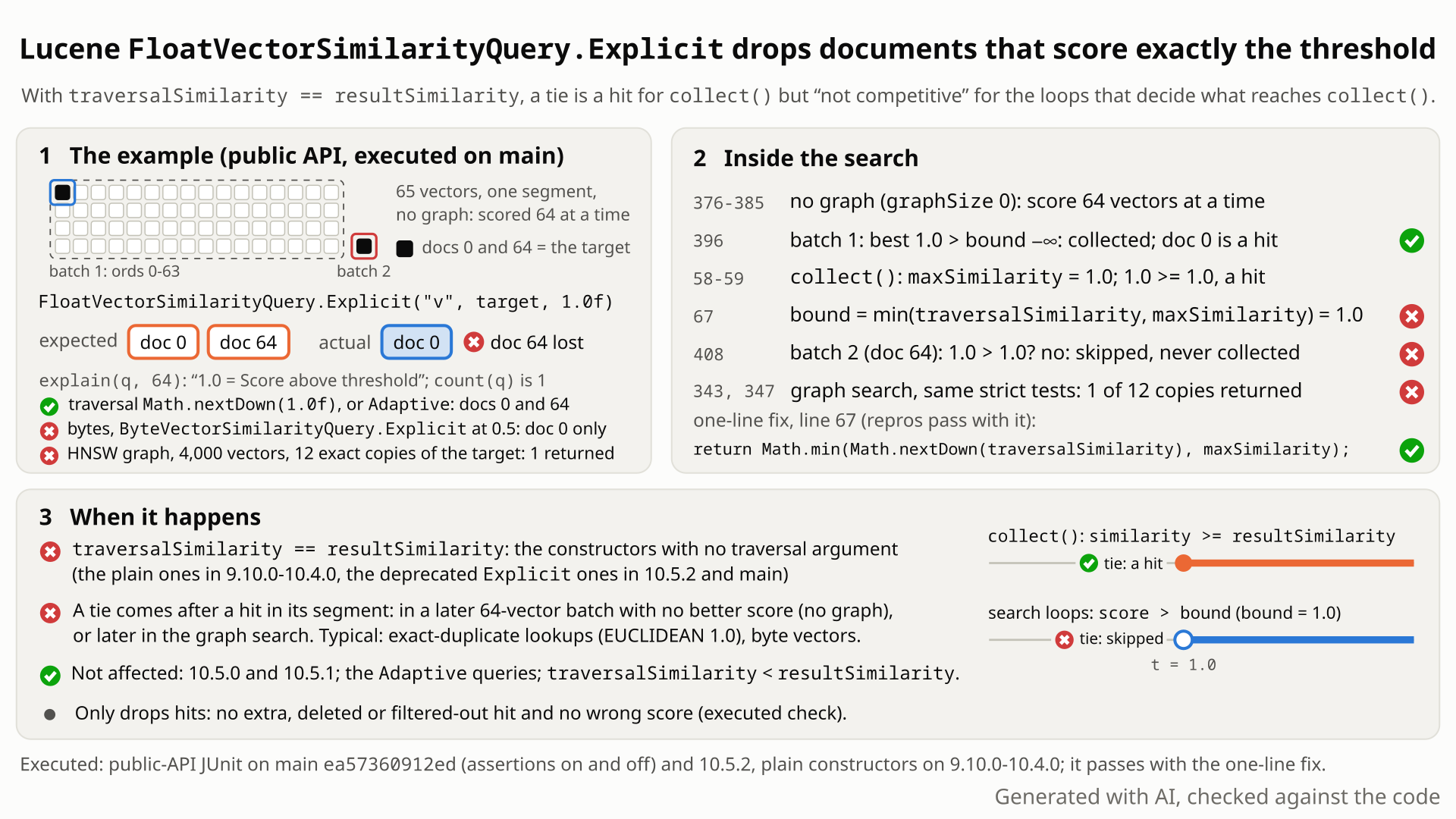
- Index 65 vectors with the default codec. Docs 0 and 64 are exact copies of the query vector
[1, 2], so their EUCLIDEAN similarity is 1.0, the highest possible; the other 63 vectors are far away. - Ask for every document with similarity >= 1.0:
new FloatVectorSimilarityQuery.Explicit("v", target, 1.0f), which sets traversalSimilarity = resultSimilarity = 1.0. You expect docs 0 and 64. - You get only doc 0, and
count()is 1, althoughexplain(query, 64)says "Score above threshold". On a 3,000-vector segment with an HNSW graph and 6 exact copies you get 1 of the 6. - Why: after doc 0 the collector reports 1.0 as its minimum competitive score, and the search treats a score equal to that bound as not worth collecting. Doc 64 sits alone in the second batch of 64 scored vectors, whose best score is not > 1.0, so it is skipped; the graph search likewise accepts only scores above 1.0.
- The same query with traversalSimilarity one step lower (
Math.nextDown(1f)) returns every copy, and on this segment every vector is scored, so this is not a graph-approximation miss. The fix is one line in the collector.
Callers that set traversalSimilarity equal to resultSimilarity: the short constructors in 9.10.0-10.4.0, the deprecated Explicit classes in 10.5.2 and main. It needs an exact score tie, which is routine for exact-duplicate lookups (EUCLIDEAN 1.0), byte vectors, or a threshold copied from a document's score. Default codec, no error; from 10.4.0 a segment needs at least 65 vectors.
Mechanism, terms and numbers846 words
A similarity-threshold vector query (FloatVectorSimilarityQuery, ByteVectorSimilarityQuery) returns every document whose similarity to the target is at least resultSimilarity; traversalSimilarity controls how far the search explores. The constructors without a traversal argument, (field, target, resultSimilarity[, filter]), set the two equal: the plain constructors in 9.10.0-10.4.0, the deprecated Explicit classes in 10.5.2 and main (the full forms behave the same when given equal values). Then, once the collector has seen a hit at exactly the threshold t, its minCompetitiveSimilarity() = min(traversalSimilarity, maxSimilarity) equals t, and every consumer treats a score equal to that bound as not competitive: the exhaustive scan of a segment without a graph collects a 64-vector batch only if its best score is > the bound, and the HNSW graph search accepts only scores >= nextUp(bound). So later documents at exactly t can be silently dropped (without a graph, those in a later batch that holds no better score; on a graph, those met after the first hit), although the query's own collect(), explain() and exact fallback all count them. On 65 vectors with exact copies of the target at docs 0 and 64 (EUCLIDEAN, t = 1.0) the query returns [0]; on a 3,000-vector HNSW segment with 6 copies, 1 of 6; with traversal one ulp lower, all of them. It needs an exact score tie, which is routine for exact-duplicate lookups, byte vectors and thresholds copied from a document's score. The fix is one line: Math.min(Math.nextDown(traversalSimilarity), maxSimilarity).
- Similarity-threshold query:
FloatVectorSimilarityQuery/ByteVectorSimilarityQuery(@lucene.experimental, "Search for all (approximate) float vectors above a similarity threshold").resultSimilarityis the score a document must reach to be returned;traversalSimilarity(<=resultSimilarity) controls how far the HNSW graph is explored. The constructors without a traversal argument,(field, target, resultSimilarity[, filter]), passresultSimilarityfor both; the full forms(field, target, traversalSimilarity, resultSimilarity[, filter])take both values. On 10.5.2 and main these are the deprecatedExplicitclasses ("Equivalent to the FloatVectorSimilarityQuery constructors in Lucene 10.4 and earlier"), next to theAdaptiveclasses, which are not affected. In 10.5.0 and 10.5.1 the plain constructors are adaptive (#15784); the nestedAdaptiveandExplicitclasses first appear in 10.5.2 (#16654/#16671). - EUCLIDEAN similarity:
1 / (1 + squared distance), so 1.0 means "identical to the target" and nothing scores higher. minCompetitiveSimilarity(): theKnnCollectormethod that the vector readers and the HNSW searcher ask for the score below which candidates are not worth visiting. Its javadoc says only "When full, the minimum score should be returned"; every consumer treats a score equal to it as not competitive, which is right for top-k collectors.
- The short constructors set
traversalSimilarity = resultSimilarity = t(FloatVectorSimilarityQuery.java:182-183,:194-195;ByteVectorSimilarityQuery.java:181-182,:193-194). Onlytraversal > resultis rejected. ExplicitVectorSimilarityCollector.collect()keepssimilarity >= resultSimilarity(:59) and tracks the best score seen (:58);minCompetitiveSimilarity()returnsMath.min(traversalSimilarity, maxSimilarity)(:66-67). After the first hit at exactly t, that is t.- Segments without a graph (with the default format, fewer than 648 vectors; from 10.4.0):
Lucene99HnswVectorsReaderscores vectors in batches of 64 and collects a batch only ifbulkScore(...) > minCompetitiveSimilarity()(:396,:408). A later batch whose best score is exactly t is skipped. Ties inside a collected batch are kept, so on this path it takes at least 65 vectors (a segment with a graph can lose a tie with a few vectors: 3 in a run with a forced graph). The scalar-quantized reader has the same gate (Lucene104ScalarQuantizedVectorsReader.java:390,:402). - Segments with a graph (every affected release):
HnswGraphSearcheraccepts a neighbour only ifscore >= Math.nextUp(minCompetitiveSimilarity())(:304,:347,:352) and skips a scored batch unless its best is > the bound (:341-343). Every node at exactly t met after the first hit is neither collected nor explored. A filter does not change this: the query pinsKnnSearchStrategy.Hnsw(0)(AbstractVectorSimilarityQuery.java:48), soFilteredHnswGraphSearcheris never chosen (HnswGraphSearcher.java:139-145,KnnSearchStrategy.java:80-82) and the same searcher runs withacceptOrds. - The query's other paths count the dropped document:
explain()says "Score above threshold" forscore >= resultSimilarity(AbstractVectorSimilarityQuery.java:175-176), and the exact fallback keepsscore >= threshold(:363).
Main ea57360912ed, default codec, one segment, traversal == result == t.
| case | hits | expected |
|---|---|---|
| 65 vectors, exact copies of the target at docs 0 and 64, EUCLIDEAN, t = 1.0 (no graph) | [0], count() 1 | [0, 64] |
| the same with byte vectors at squared distance 1, t = 0.5 | [0] | [0, 64] |
the 65-vector case plus a MatchAllDocsQuery filter (every document has a vector, so the scan reaches the visit limit and falls back to the exact scan) | [0, 64] | [0, 64] |
| 3,000 vectors with an HNSW graph, 6 exact copies | [7] (1 of 6) | 6 copies |
| 4,000 vectors with an HNSW graph, 12 exact copies, with or without a 25% filter | 1 of 12 | 12 |
controls: traversal = Math.nextDown(t), or the Adaptive query | every copy | every copy |
Exposure and likelihood487 words
- Who is exposed. Code that builds a similarity-threshold query with traversalSimilarity equal to resultSimilarity: the plain constructors without a traversal argument in 9.10.0-10.4.0 (the short, non-deprecated forms
(field, target, resultSimilarity[, filter])),[Float|Byte]VectorSimilarityQuery.Explicitwith those arguments in 10.5.2 and main (deprecated), or a full form(field, target, traversalSimilarity, resultSimilarity[, filter])with equal values. Not 10.5.0 or 10.5.1 (adaptive collector, noExplicit), not theAdaptivequeries, notFloat16VectorSimilarityQuery, and not any call with traversal strictly below result. - What it takes. A document scoring exactly the threshold after another vector at or above it was collected in the same segment (without a graph, only in a later 64-vector batch that holds no better score). Exact-duplicate lookup at EUCLIDEAN 1.0 always qualifies (nothing scores above 1.0, so every further copy is a tie); byte vectors give many equal scores; so does a threshold copied from a known document's score. For float embeddings with an arbitrary threshold an exact tie is very unlikely.
- How much is lost. On a segment with a graph, every tie met after the first hit: 1 of 6 and 1 of 12 copies in the runs. On a segment without a graph (fewer than 648 vectors with the default format, from 10.4.0), a tie in a later 64-vector batch that holds no better vector. Rarely an above-threshold document reachable only through tied graph nodes goes too: in a 120-query check, 11 of 6,699 missing documents were above the threshold, and the fix recovered all 11 (attributed to tied nodes, inferred).
- Silent and inconsistent. No error;
count()matches the short hit list, whileexplain()says the missing documents match. The answer changes with document order, with an all-matching filter (no-graph segments in which every document has a vector, 10.4.0 on) and with a one-ulp change of traversalSimilarity. As aMUST_NOTclause, a tied document is not excluded (64 hits instead of 63). - Settings and size. Default codec, directory and
IndexSearcher. From 10.4.0 a segment needs at least 65 vectors: below 648 it has no graph and is scanned in 64-vector batches, and ties in the first collected batch are kept. Smaller segments are hit only when they have a graph: with a format whose tiny-segment threshold is 0 (executed with 3 vectors), or on 9.10.0-10.3.2, which had no tiny-segment threshold (read; not run below 65 vectors). The scalar-quantized formats have the same gate; a random hunt hit them, but no dedicated test targets them. - Downstream. Solr's vector-similarity parser defaults
minTraverseto -Infinity (not affected), but a request may setminTraverseequal tominReturn, and an open Solr issue (SOLR-17713) shows a user doing that. The OpenSearch k-NN plugin uses the Adaptive query or 0.95 x threshold (not affected); no Elasticsearch use was found. - How likely. Rare: it needs both the equal-thresholds setting and an exact tie, and no public report was found in the two and a half years since 9.10.0 (released 2024-02-20).
FloatVectorSimilarityQuery.Explicit with traversalSimilarity == resultSimilarity drops a document whose similarity equals the threshold once an earlier hit at the threshold was collected (65 vectors, exact copies of the target at doc 0 and doc 64, EUCLIDEAN threshold 1.0).
/*
 * Licensed to the Apache Software Foundation (ASF) under one or more
 * contributor license agreements.  See the NOTICE file distributed with
 * this work for additional information regarding copyright ownership.
 * The ASF licenses this file to You under the Apache License, Version 2.0
 * (the "License"); you may not use this file except in compliance with
 * the License.  You may obtain a copy of the License at
 *
 *     http://www.apache.org/licenses/LICENSE-2.0
 *
 * Unless required by applicable law or agreed to in writing, software
 * distributed under the License is distributed on an "AS IS" BASIS,
 * WITHOUT WARRANTIES OR CONDITIONS OF ANY KIND, either express or implied.
 * See the License for the specific language governing permissions and
 * limitations under the License.
 */
package org.apache.lucene.search;

import java.util.ArrayList;
import java.util.List;
import org.apache.lucene.document.Document;
import org.apache.lucene.document.KnnFloatVectorField;
import org.apache.lucene.index.DirectoryReader;
import org.apache.lucene.index.IndexWriter;
import org.apache.lucene.index.IndexWriterConfig;
import org.apache.lucene.index.VectorSimilarityFunction;
import org.apache.lucene.store.ByteBuffersDirectory;
import org.apache.lucene.store.Directory;
import org.apache.lucene.tests.util.LuceneTestCase;
import org.apache.lucene.tests.util.TestUtil;

@SuppressWarnings("deprecation")
public class TestExplicitSimilarityThresholdTie extends LuceneTestCase {

  public void testFloatExactDuplicates() throws Exception {
    float[] target = {1f, 2f};
    try (Directory dir = new ByteBuffersDirectory()) {
      try (IndexWriter w =
          new IndexWriter(dir, new IndexWriterConfig().setCodec(TestUtil.getDefaultCodec()))) {
        for (int i = 0; i < 65; i++) {
          Document doc = new Document();
          float[] v = (i == 0 || i == 64) ? target : new float[] {100f, 100f};
          doc.add(new KnnFloatVectorField("v", v, VectorSimilarityFunction.EUCLIDEAN));
          w.addDocument(doc);
        }
      }
      try (DirectoryReader reader = DirectoryReader.open(dir)) {
        Query query = new FloatVectorSimilarityQuery.Explicit("v", target, 1.0f);
        List<Integer> docs = new ArrayList<>();
        for (ScoreDoc sd : new IndexSearcher(reader).search(query, 10).scoreDocs) {
          docs.add(sd.doc);
        }
        // docs 0 and 64 are exact copies (similarity 1.0 >= resultSimilarity 1.0); main returns [0]
        assertEquals(List.of(0, 64), docs);
      }
    }
  }
}
# in a copy of this finding's repro folder (repro/LFV-467/, which holds src/)
# Lucene checkout at the tested commit, built with: ./gradlew --no-daemon assemble   (JDK 25)
LUCENE=/path/to/lucene; V=12.0.0-SNAPSHOT
CP=$LUCENE/lucene/core/build/libs/lucene-core-$V.jar
CP=$CP:$LUCENE/lucene/codecs/build/libs/lucene-codecs-$V.jar
CP=$CP:$LUCENE/lucene/test-framework/build/libs/lucene-test-framework-$V.jar
CP=$CP:randomizedtesting-runner-2.9.2.jar:junit-4.13.2.jar:hamcrest-3.0.jar   # test-framework dependencies (Maven Central)
CP=$CP:junit-platform-console-standalone-6.1.3.jar   # JUnit Platform console launcher (Maven Central)

javac -d classes -cp "$CP" $(find src -name '*.java')

# run 1: assertions on, seed DEADBEEF
java -ea -esa --add-modules jdk.incubator.vector --enable-native-access=ALL-UNNAMED -Dtests.seed=DEADBEEF \
     -cp "classes:$CP" org.junit.platform.console.ConsoleLauncher \
     execute --select-class org.apache.lucene.search.TestExplicitSimilarityThresholdTie
- Expected vs actual
- Expected hits [0, 64] (both have similarity 1.0 >= resultSimilarity); main returns [0].
More files, environment, full output35 words
| lucene | Lucene main e1faeba08bde (2026-11-02) |
|---|---|
| jdk | 25.0.3+9-LTS |
# Lucene main 645d4fe14a20, assertions on (-ea), seed DEADBEEF: 1 test(s) run, 1 failed
    => java.lang.AssertionError: expected:<[0, 64]> but was:<[0]>
       org.junit.Assert.fail(Assert.java:89)
       org.junit.Assert.failNotEquals(Assert.java:835)
       org.junit.Assert.assertEquals(Assert.java:120)
       org.junit.Assert.assertEquals(Assert.java:146)
org.apache.lucene.search.TestExplicitSimilarityThresholdTie.testFloatExactDuplicates(TestExplicitSimilarityThresholdTie.java:54)- The query's own code counts a tie as a match:
collect()and the exact fallback use>=, andexplain()says "Score above threshold". - Every vector of the 65-vector segment is scored, and a traversal one step lower returns every copy: not a graph-recall miss.
- The strict tie rule was made for top-k (#12770) while this query (#12679) was in review.
The full argument376 words
- Contract text. Collector javadoc (
ExplicitVectorSimilarityCollector.java:35-37): "The graph is traversed till better scoring nodes are available, or the best candidate is below {@link #traversalSimilarity}. All traversed nodes above {@link #resultSimilarity} are collected." A tie is not "below".collect()(:59) uses>=;explain()(AbstractVectorSimilarityQuery.java:175-176) returns "Score above threshold" forscore >= resultSimilarity; the exact fallback (:363) usesscore >= threshold. - Release notes. The 9.10.0 CHANGES entry for #12679: "find all vectors scoring above a
resultSimilaritywhile traversing the HNSW graph till better-scoring nodes are available, or the best candidate is below a score oftraversalSimilarityin the lowest level." - Upstream tests.
TestVectorSimilarityCollector.testExplicitResultCollection(:53-85) expects node 4 (score 0.5) at resultSimilarity 0.5 under "All nodes above resultSimilarity appear in order of collection" (:76-78).BaseExplicitVectorSimilarityQueryTestCase.testVectorsAboveSimilaritybuilds the expected set withscore >= resultSimilarity(:404) and asserts all are returned (:427-428), but with traversal = -Infinity (:414), which hides the tie. Three upstream tests do run traversal == result (testFallbackToExactandtestApproximateat the exact score of an indexed document,testExtremesat -Infinity and +Infinity), but none checks that tied documents are returned:testFallbackToExactasserts only the fallback to exact search (:452),testApproximateonly an upper bound (:489). - The PR's own definition. In #12679 the author describes the baseline as "any vector with a score >= resultSimilarity".
- History. #12770 (merged 2023-11-07, 9.9.0) made the graph searcher's neighbour test strict because the search over-explored the graph on equal scores (its commit message names lower dimensionality and quantization); for top-k an equal score does not raise the cutoff. #12679 was in review then; the traversal = result default was proposed on 2023-11-30, and the PR merged on 2023-12-11 without adapting the collector. #14215 (10.2.0) kept the strict form; in its review jimczi noted that this contract "does place the responsibility on the various implementers". #15021 (10.4.0) added the exhaustive batch gate, and #16654 (10.5.2) restored the 10.4 collector's body, renamed and deprecated, behind
Explicit. - Counterfactuals. On 9.10.0, the pre-#12770
>=in the graph searcher makes the repro pass; on 10.4.0, an inclusive batch gate makes it pass; on main, the one-line collector fix makes it pass.
The devil's-advocate check358 words
The strongest "works as designed" case (built on purpose by a devil's-advocate verifier and by a cross-model refute review, which rated it strong): (1) the queries are documented as "(approximate)" and @lucene.experimental, and no upstream traversal == result test checks that tied documents are returned (testApproximate asserts an upper bound); (2) the strict tie rule in the searchers is deliberate (#12770, #14215), and TestFilteredHnswGraphSearcher.testAllTiedScoresBoundedVisitation bounds equal-score exploration on purpose; (3) completeness is promised only for traversal = -Infinity: #15836 (10.5.0) made that case exact "to guarantee completeness"; (4) "above" can be read as strictly above, and testExplicitResultCollection pins the bound to min(traversal, best); (5) Explicit is a deprecated shim that #16654 proposed to remove.
Why it fails: (1, 3) approximation and #15836 cover documents the search never reaches (#15836 fixed a disconnected graph, where the missed document scored 0.1033 against 0.0979, not a tie); here the tie is reached: on a segment without a graph it is scored and then thrown away at a batch boundary, and on a graph a traversal one ulp lower finds every copy on the same graph; (2) the strict rule and the bounded tie test serve top-k collectors, which still pass with the fix, while this collector defines its results with >=; (4) collect(), explain(), the exact fallback and the upstream unit test all mean >=, the pinned bound uses delta 1e-3 with traversal 0.3 below result 0.5, and under either reading one document at exactly 1.0 is returned and another is not, depending only on document order; (5) deprecation is a won't-fix risk, not intent: 9.10.0-10.4.0 hit it through the primary constructors, and Explicit still ships on main and branch_10_6. Verdict: a defect. The devil's advocate rated the intended argument weak, cross-model reviews moderate, the refute review strong (it could not run code); the reproducer and the adjudication say real. The cross-model fact check of the brief rated the case moderate for the no-graph path and strong for the graph path, where the query is approximate and equal-score exploration was bounded on purpose, so expect maintainers to weigh the graph case that way.
Recommended A: report a bound one ulp below traversalSimilarity
One line in ExplicitVectorSimilarityCollector.minCompetitiveSimilarity(): return Math.min(Math.nextDown(traversalSimilarity), maxSimilarity), so a score equal to the threshold stays competitive. The strict search gates and top-k collectors are untouched. With it the repro passes, and 90 similarity-query tests and 891 vector, kNN and HNSW tests pass.
@Override
public float minCompetitiveSimilarity() {
  // Searchers treat a score equal to minCompetitiveSimilarity() as not competitive, but a score
  // equal to traversalSimilarity must still be traversed (and, when traversalSimilarity ==
  // resultSimilarity, collected).
  return Math.min(Math.nextDown(traversalSimilarity), maxSimilarity);
}
All options and trade-offs5 options · 698 words
The cause is one inclusive threshold handed to exclusive gates, and the gates are right for top-k collectors, so the fix belongs in the collector. Option A was built and validated in a scratch worktree at ea57360912ed (removed afterwards); the others were not built. Option A is this doc's recommendation: it also covers the full constructors, but whether equality should include ties is the maintainers' call, and its cost on tie-heavy data was not benchmarked. Users can work around it today with a full constructor (field, target, traversalSimilarity, resultSimilarity[, filter]) and traversalSimilarity = Math.nextDown(resultSimilarity), or with the Adaptive query on 10.5.2 and later (in 10.5.0 and 10.5.1 the plain constructors are already adaptive).
In ExplicitVectorSimilarityCollector (and VectorSimilarityCollector in 9.10.0-10.4.0: 10.4.0 :65, 9.10.0 :64), return Math.min(Math.nextDown(traversalSimilarity), maxSimilarity). The bound is then below resultSimilarity, so any batch holding a score >= resultSimilarity passes the exhaustive gate, and the graph searcher's acceptance bound nextUp(bound) is at most traversalSimilarity (for finite thresholds; with traversalSimilarity -Infinity nothing changes, and the fix does not change how a NaN traversalSimilarity, which the constructor check lets through, is handled).
@Override
public float minCompetitiveSimilarity() {
  // Searchers treat a score equal to minCompetitiveSimilarity() as not competitive, but a score
  // equal to traversalSimilarity must still be traversed (and, when traversalSimilarity ==
  // resultSimilarity, collected).
  return Math.min(Math.nextDown(traversalSimilarity), maxSimilarity);
}
Trade-offs
- Extra work. With many exact ties at the threshold the graph search now explores all of them; they are all results, so the work is proportional to the output. With traversal < result, nodes scoring exactly
traversalSimilarityare now explored, as the javadoc ("below traversalSimilarity") describes. The worst case is a large plateau of equal scores at a traversalSimilarity below resultSimilarity: the graph search now explores it in full and returns none of it. No benchmark was run, and the upstream bounded-tie test uses a top-k collector, so it does not cover this collector. - Scope. The strict gates in the readers and searchers, and every top-k collector, are unchanged. The upstream
testExplicitResultCollectionpinsminCompetitiveSimilaritywith delta 1e-3 and still passes. - Backports. Not run on releases before main; the same line exists in 9.10.0-10.4.0 under the old class name.
What the checks validated
- Stock: the 3 tests fail 3 of 3 through gradle, assertions on and off, seeds DEADBEEF and 5EED1234.
- Patched, assertions on and off: the 7 closest classes (the repro,
TestExplicitFloatVectorSimilarityQuery,TestExplicitByteVectorSimilarityQuery,TestVectorSimilarityCollector,TestFloatVectorSimilarityQuery,TestByteVectorSimilarityQuery,TestFloat16VectorSimilarityQuery): 90 tests, 0 failures, 3 skipped. - Patched:
org.apache.lucene.search.*Vector*,*Knn*,org.apache.lucene.util.hnsw.*,codecs.lucene99.*,codecs.lucene104.*: 891 tests, 0 failures, 23 skipped. ecjLint,forbiddenApis(main and test) andcheckGoogleJavaFormaton core pass.- Earlier runs: the finder's, the independent reproducer's and the root-cause verifier's tests pass with the fix; 140 and 201 upstream similarity-query and collector tests pass; the random hunt's 473 failures drop to 0.
Same effect for the constructors without a traversal argument; this is exactly the one-ulp control that was run.
Trade-offs
Leaves the full 4- and 5-argument constructors (field, target, traversalSimilarity, resultSimilarity[, filter]) broken when they are given equal values, and changes toString() and equals() of the short forms. Not built.
Run only as a counterfactual: on 9.10.0 (graph searcher) and 10.4.0 (exhaustive gate) it makes the repro pass.
Trade-offs
Not recommended: it undoes the deliberate top-k optimisation of #12770 and #14215 for every collector, and would be needed in each reader and searcher, including the scalar-quantized reader.
State that a score equal to the returned value is treated as not competitive, as raised in the #14215 review.
Trade-offs
Documentation only; it prevents the next collector from repeating the mistake but fixes nothing by itself.
As #16654 proposes.
Trade-offs
Fixes main eventually, not 10.5.2, branch_10_6 or the 9.10.0-10.4.0 releases. Open PR #16811 rewrites the exhaustive path with a per-vector scores[j] > minScore check that, by code reading only, would widen the drop; A should land first or with it.
While building a metamorphic test harness for the kNN and similarity queries, the finder read the exhaustive-scan batch gate and wrote a probe: the same query returned one copy without a filter and both with an all-matching filter. Random small indexes checked against an exact brute-force reference then hit it 473 times, always with traversal equal to result.
The method in full172 words
Method: code reading, then random differential (metamorphic) testing (the registry's non-formal tier; the finder tagged it semi-formal). A hunt unit built a harness of random small indexes (0-300 documents, 1-4 segments, deletions, small-integer vectors so every similarity is computed exactly, several vector formats) and checked every kNN and similarity query against an exact brute-force reference.
- Reading the exhaustive-scan gate
bulkScore(...) > minCompetitiveSimilarity()next to the collector's>=, the finder wrote a public-API probe:Explicit(field, target, 1.0f)returned[0], the same query with aMatchAllDocsQueryfilter[0, 64]. - The random hunt's relation "similarity query == documents with exact score >= t" then failed 473 times in 55,970 traversal == result checks over 1,496 indexes (default codec and both scalar-quantized formats), with 0 failures for traversal -Infinity, traversal t - 0.25 and the Adaptive query, 0 when no segment exceeded 60 vectors, and 0 with the fix.
- The finder minimised it to the 65-vector JUnit; an independent reproducer, a root-cause verifier, a devil's advocate and an adjudication followed (see the checks).
No prior report found: 261 queries over Lucene, Solr, OpenSearch and Elasticsearch issues, PRs and commits, the JIRA archive, the Lucene mailing lists and the web, 32 hits read (2026-10-26). Closest is #14215, which set the strict tie rule for top-k only.
Searches4 searches
None of the items read reports this bug.
| Where | When | How | Found |
|---|---|---|---|
| GitHub issues, PRs and commits (apache/lucene main, branch_10x, branch_10_6; apache/solr; the OpenSearch k-NN plugin and OpenSearch; Elasticsearch) | 2026-10-26 | a scripted prior-report search in four runs (class, method, symptom, mechanism and downstream phrasings) (210 queries) plus 51 manual searches; 261 recorded queries | no report of this bug; no open PR changes the collector's bound or the gates' equality |
| Related items (read) | 2026-10-26 | 32 hits read | mechanism only: #14215 (strict nextUp rule; review remark on the contract), #12770, #14249, #14366, #16409, #15021 (top-k gates); #12679, #15784, #16654/#16671 (introduction, adaptive replacement, Explicit restoration); #12955, #15816/#15836 (disconnected graph, not a tie) |
| Open PRs | 2026-10-26 | PRs touching the vector readers and the similarity collectors | #16811 rewrites the exhaustive path and, by code reading only, would widen the drop; #15802 and #16882 do not change the bound |
| Apache JIRA (LUCENE, SOLR) and the dev@, java-user@, issues@, commits@ lists | 2026-10-26 | tool queries plus manual JIRA searches | SOLR-17713 (open): a user sets minTraverse equal to minReturn, the trigger configuration, without reporting the drop |
Introduced in 9.10.0 by #12679 (merged 2023-12-11), which added the query; affected through 10.4.0. Gone in 10.5.0 and 10.5.1 (adaptive collector), back in 10.5.2 when #16654 restored the 10.4 behaviour as the deprecated Explicit classes. Still on main and branch_10_6.
Versions tested8 rows
Introduced by #12679 "Add support for similarity-based vector searches" (kaivalnp), cd195980ecbc on main, committed 2023-12-11, backport 8089b8c9d337, first released in 9.10.0. The graph searcher was already strict (#12770, merged 2023-11-07), so the code was defective the day it merged. From 10.4.0, #15021 (exhaustive batch gate) and #14963 (no graph for small segments) moved the repro's 65-vector case to the exhaustive scan. #15784 (be2af1e7b43, 10.5.0) switched the plain constructors to the adaptive collector; #16654 (bc9adc96cc58, 2026-09-13; backport #16671) restored the 10.4 collector as Explicit in 10.5.2.
| Version or commit | Verdict | Result |
|---|---|---|
| 9.9.0, 9.9.2 | no API | does not compile: the query does not exist yet (9.9.1 was not run; its release tag has no such class) |
| 9.10.0, 9.11.0, 9.11.1, 9.12.0-9.12.3 | affected | fail 2/2 (9.12.3 also with assertions off); plain constructors, graph search |
| 10.0.0, 10.1.0, 10.2.0-10.2.2, 10.3.0-10.3.2 | affected | fail 2/2; plain constructors, graph search |
| 10.4.0 | affected | fail 2/2, assertions on and off; plain constructors, exhaustive scan |
| 10.5.0, 10.5.1 | not affected | pass 2/2: the plain constructors use the adaptive collector |
| 10.5.2 | affected | fail 2/2, assertions on and off; deprecated Explicit |
main ea57360912ed | affected | fail 2/2, assertions on and off; this doc's 3 tests fail 3/3 |
9.10.0 with the pre-#12770 >=; 10.4.0 with an inclusive batch gate | counterfactual | pass 2/2: pins the cause per era |
An independent reproducer, a devil's advocate and an adjudication say real; cross-model reviews (OpenAI GPT-5.6, reading only) agreed on the root cause, two rating it real. Every executed check fails on stock and passes with the one-line fix, and this doc's own gradle runs reproduced it and validated the fix.
Checks and verdicts689 words
Every check ran on main ea57360912ed with assertions on and off unless noted. The cross-model reviews could only read code; their execution evidence is separate re-runs of the finder's test (fail 2 of 2 each time).
| Check | Verdict | What it found |
|---|---|---|
| Finder (a hunt unit) | candidate | Probe, then 473 random-hunt failures, 0 with the fix; the 2-test JUnit fails 2 of 2 on main, 10.5.2, 10.4.0, 10.3.2, 10.0.0, 9.12.3 and 9.10.0, and passes with the fix. |
| Refute review (OpenAI GPT-5.6, reading only) | not real (medium), procedural | It had no executed repro of its own, so it returned not real; it agreed with the mechanism and that the inputs are within the contract, and rated the intended argument strong (completeness is promised only for traversal -Infinity). A separate run re-ran the repro: 2 of 2 fail. |
| Intended-behaviour review (OpenAI GPT-5.6, reading only) | real, medium | Intended argument moderate: the short constructors create the equality, and collect(), explain(), the exact fallback and the tests all use >=; root cause agreed. |
| Independent reproducer | real | Own tests with two different vectors, both at distance 1 from the target, so both score exactly 0.5: [10] instead of [10, 150], 5 of 5 fail on main and 10.5.2; 5 controls pass; 10 of 10 pass with the fix; the plain-constructor variant fails on 10.4.0, 9.12.3 and 9.10.0, passes on 10.5.1. The all-matching-filter relation does not reproduce on 9.x. |
| Root-cause review (OpenAI GPT-5.6, reading only) and separate checks | real, medium | The review agreed: one cause with two consumers (exhaustive scan and graph search), intended argument moderate. A separate test: 1 of 12 copies on a 4,000-vector graph, with and without a filter; all 12 with the fix; 201 upstream tests pass stock and with the fix. |
| Devil's advocate | real, intended argument weak | Built and rejected four works-as-designed readings; probe on main, 10.4.0 and 9.10.0: 1 of 6 copies on a 3,000-vector graph, 6 of 6 with a one-ulp lower traversal; found the #12770 / #12679 timeline. |
| Adjudication | confirmed, high | Re-ran the independent reproduction's suite on a fresh seed (5 of 5 fail, assertions on and off; controls pass) and the finder's repro (fails; passes with the fix). Class: silent wrong results. |
| Follow-up, registry re-runs and audit | confirmed | History sweep of 38 runs, security assessment (none), prior-report search (new); fresh-seed re-runs and an independent credibility audit kept the row. |
| This doc's gradle runs | reproduced; fix validated | 3 of 3 fail stock (two seeds, assertions on and off); with the fix 90 closest and 891 broader tests pass, and the static checks pass. |
| Fact checks of this doc | core claims hold; wording corrected | An independent fact check re-ran the repro and the fix through gradle at ea57360912ed (3 of 3 fail stock with assertions on and off; 38 tests pass with the fix) and read every cited line; a cross-model fact check (OpenAI GPT-5.6, reading only) read the same sources. Neither found an error in the root cause, the repro, the affected versions or the fix. Their wording, scope and version corrections are applied on this page and in the brief; one point was rejected (resolution in the hunt's record). An independent diagram check passed; its wording points were applied and the visuals re-rendered. |
| Correction to the registry row | wordings out of date | The registry row (fact strip and registry card) still has wordings the checks corrected here: title, introduced_commit, affected_versions, notes and likelihood_note say "3/4-argument constructors" (there are two 4-argument overloads, and only (field, target, resultSimilarity, filter) sets the thresholds equal); impact_note says "no index size is needed" (from 10.4.0 a segment needs at least 65 vectors); introduced_commit says the collector was "restored verbatim" (same body, renamed and deprecated); notes lists FilteredHnswGraphSearcher as a consumer (this query never reaches it), calls segments of at most 64 vectors "safe" (only from the batch gate) and says a document's vector can be moved "below any threshold by one ulp" (not for byte vectors); upstream says "about 45 manual searches" (51); likelihood_note says "nothing was reported" (no public report was found). |
The diagram as a still image, generated with AI and checked against the code. It is under 10 MB, the limit for a GitHub attachment.
- PNG 516 KB
Finding record, Lucene and upstream sources, repro files and diagram notes1,838 words
- Registry title
- FloatVectorSimilarityQuery and ByteVectorSimilarityQuery with traversalSimilarity == resultSimilarity (the 3- and 4-argument constructors: the plain ones in 9.10.0-10.4.0, the deprecated Explicit classes in 10.5.2 and main) silently drop documents whose similarity is exactly resultSimilarity, because the collector's minCompetitiveSimilarity() rises to the inclusive threshold and every searcher treats an equal score as not competitive
- Area
- search / vector similarity-threshold queries (ExplicitVectorSimilarityCollector with the exhaustive scan and the HNSW graph search)
- Priority
- Low, rank 281: Needs an exact score tie at the threshold, and on 10.5.2 and main only the deprecated Explicit similarity-query classes are affected.
- Impact class
- silent wrong results
- Impact note
- Applications that run a similarity-threshold vector query with traversalSimilarity equal to resultSimilarity on the default codec, directory and IndexSearcher (in 9.10.0-10.4.0 the plain, non-deprecated FloatVectorSimilarityQuery/ByteVectorSimilarityQuery(field, target, resultSimilarity[, filter]) constructors; in 10.5.2 and main only the deprecated Explicit classes; 10.5.0 and 10.5.1 are not affected) silently miss documents whose score is exactly the threshold once another vector at or above it was seen earlier in the same segment: deterministically on the graph path for every tie met after the first hit (1 of 6 and 1 of 12 exact copies returned on 3,000- and 4,000-vector graphs), and on segments below about 650 vectors, which have no graph, whenever the tie sits in a later 64-vector scoring batch with no better vector; rarely an above-threshold document reachable only through tied graph nodes is lost too; no index size is needed, only an exact score tie, which is natural for exact-duplicate lookups (EUCLIDEAN threshold 1.0), byte vectors (integer arithmetic) and thresholds copied from a known document's score.
- Summary
- You index vectors with the default codec and run FloatVectorSimilarityQuery.Explicit(field, target, 1.0f) on main or 10.5.2 (the plain FloatVectorSimilarityQuery(field, target, 1.0f) on 9.10.0-10.4.0), which sets traversalSimilarity = resultSimilarity, to find every exact copy of target under EUCLIDEAN, and you expect every document with similarity >= 1.0, as collect() ('similarity >= resultSimilarity'), explain() ('Score above threshold') and the query's own exact fallback all count them. Instead only the first copy comes back: a 65-vector segment with copies at doc 0 and doc 64 returns [0] and count() 1, the same query with a MatchAllDocsQuery filter returns [0, 64], a 4,000-vector HNSW segment returns 1 of its 12 copies, and a traversalSimilarity one ulp lower returns all of them (byte vectors at an exact 0.5 behave the same). Once a hit at the threshold is collected, ExplicitVectorSimilarityCollector.minCompetitiveSimilarity() = min(traversalSimilarity, maxSimilarity) equals the inclusive result threshold, and both the exhaustive scan (a 64-vector batch is collected only if its best score > minCompetitiveSimilarity()) and the graph search (score >= nextUp(minCompetitiveSimilarity())) treat an equal score as not competitive; the one-line fix returns min(nextDown(traversalSimilarity), maxSimilarity).
- Introduced
- cd195980ecbcb45e19ce9465854fed0b6be79ea7 on main (GITHUB#12679 'Add support for similarity-based vector searches' by kaivalnp, merged 2023-12-11) and its branch_9x backport 8089b8c9d3374dc4d451a4280daae85e0b139b84, first released in 9.10.0 [read: git blame, git log -L and git show of the merge parent in the full-history clone; exec: 9.9.0 and 9.9.2 lack the API, 9.10.0 fails]: the new collector kept similarity >= resultSimilarity but reported min(traversalSimilarity, maxSimilarity) as minCompetitiveSimilarity, and the 3/4-argument constructors passed resultSimilarity as traversalSimilarity (a default the author proposed in the PR on 2023-11-30), while #12770 (e1ce1d692ca4, merged 2023-11-07 during that review, released in 9.9.0) had already made HnswGraphSearcher's level-0 neighbour test strict ('>'), so the code was defective the day it merged. Not adapted when #15021 (0421a8de771e, 10.4.0) added the exhaustive-scan batch gate 'max > minCompetitiveSimilarity()', and #14963 (4a7c9c2780b, 10.4.0) stopped building graphs for small segments, so that gate became the normal path for them. Gone in 10.5.0 (#15784, be2af1e7b43: the plain constructors use the adaptive collector) and restored verbatim in 10.5.2 by #16654 (bc9adc96cc58 on main, 2026-09-13; backport #16671 5caef2a1fda9) as the deprecated ExplicitVectorSimilarityCollector behind [Byte|Float]VectorSimilarityQuery.Explicit [read + exec] (2023-12-11 (main cd195980ecbc, #12679); reintroduced 2026-09-13 (main bc9adc96cc58, #16654; backport #16671, released in 10.5.2))
- First affected version
- 9.10.0 [exec] (the release that added the query; 9.9.0 and 9.9.2 have no FloatVectorSimilarityQuery [exec: compile error]); 10.5.0 and 10.5.1 are not affected [exec] and 10.5.2 is affected again [exec]
- Affected versions
- 9.10.0, 9.11.0, 9.11.1, 9.12.0-9.12.3, 10.0.0, 10.1.0, 10.2.0-10.2.2, 10.3.0-10.3.2 and 10.4.0 through the plain 3/4-argument constructors, and 10.5.2 and main ea57360912ed through the deprecated Explicit 3/4-argument constructors (and the 5-argument form with equal values) [exec: the finder's JUnit fails 2 of 2 on every one of these releases in the follow-up history sweep, also with -da on 9.12.3, 10.4.0, 10.5.2 and main; the independent reproduction on main, 10.5.2, 10.4.0, 9.12.3 and 9.10.0; a separate run on main, 10.5.2 and 9.10.0; the intended-behaviour check on main, 10.4.0 and 9.10.0]; not affected: 10.5.0 and 10.5.1 (adaptive collector, no Explicit class) [exec], before 9.10.0 the API does not exist [exec: 9.9.0, 9.9.2]. Path by era [exec: probe and counterfactual shadow runs]: 9.10.0-10.3.2 drop the tie in the HNSW graph search (the 65-vector repro segment has a graph there); from 10.4.0 a segment below the graph threshold has no graph and the exhaustive scan's batch gate drops it, while larger segments still drop ties in the graph search [exec on main, 10.4.0 and 9.10.0]. Float16VectorSimilarityQuery has no Explicit variant and the Adaptive queries are not affected [read; Adaptive exec]. Upstream main 49483e82b357 (unreleased) and branch_10_6 still have the code, so the released 10.6.0 (2026-10-29) has it [read, 2026-10-26].
- Status
- documented (brief, checks and a per-finding doc exist)
- Verification
- Confirmed by AI-run checks: an independent repro, a cross-model review that disputed it (the adjudication ruled it real), an intended-behaviour check, a prior-report search and a skeptical audit; not yet triaged by a person.
- Found by
- non-formal: code reading; also reached by randomized/MBT
- Upstream and prior reports
- none found (2026-10-26, read-only; the prior-report record): the finder's run of the scripted prior-report search and three follow-up runs (GitHub issues, PRs and commits on apache/lucene, downstream repositories, the dev@, java-user@, issues@ and commits@ lists, the JIRA archive and the web) plus about 45 manual searches (apache/lucene main, branch_10x and branch_10_6 commits by path, apache/solr, the OpenSearch k-NN plugin and OpenSearch, Elasticsearch, Apache JIRA LUCENE and SOLR): 261 recorded queries, 32 hits read, none the same bug; the independent reproduction's and the intended-behaviour check's own read-only searches found nothing either. Not fixed upstream: ExplicitVectorSimilarityCollector.java was last changed by #16654/#16671 on main (49483e82b357), branch_10x and branch_10_6, and no open PR changes its minCompetitiveSimilarity or the strict gates. Closest, mechanism only: #14215 (merged 2025-02; made HnswGraphSearcher accept only score >= nextUp(minCompetitiveSimilarity()); in its review GitHub jimczi remarked that the current KnnCollector#minCompetitiveSimilarity form 'does place the responsibility on the various implementers'; threshold collectors are not discussed), #12770 (strict level-0 test, merged during #12679's review), #14249/#14366/#16409 (top-k tie and boundary fixes), #15021 (exhaustive batch gate, no discussion of ties). Context: #12679 (the author defines the baseline as 'any vector with a score >= resultSimilarity'), #15784 (adaptive collector, not affected), #16654/#16671 (restored the 10.4 behaviour as the deprecated Explicit classes and proposed removing them), #12955 and #15816/#15836 (missed documents with traversal = -Infinity from a disconnected graph, not a tie), #13611 (kNN versus similarity-query recall); SOLR-17713 (open, 2025-03: a Solr user sets minTraverse equal to minReturn, the trigger configuration, without reporting this bug). Open PR #16811 (2026-10-11) rewrites the exhaustive path and adds a per-vector 'scores[j] > minScore' check, which by code reading only (not executed) would widen the drop to tied vectors inside a batch that holds a better vector. Gaps: GitHub search is capped per query and two manual REST calls hit the rate limit (re-run through GraphQL); keyword searches cannot prove absence; private security reports are invisible.
- Lucene commit tested
- main
ea57360912ed(2026-10-26): this doc's three tests through gradle in a scratch worktree (assertions on and off, seeds DEADBEEF and 5EED1234), the one-line fix with the 7 closest similarity-query and collector classes (90 tests, assertions on and off), the vector, kNN, HNSW and codec test classes (891 tests) and the core static checks; the finder's two tests on the Maven Central jars of 21 of the 22 releases from 9.9.0 to 10.5.2 (all but 9.9.1, which has no such query; follow-up history sweep, SHA-1 checked); the hunt's main refresha9779ef3c19still reproduces. OpenJDK 25.0.3, Linux aarch64.
- Finding record
lucene/core/src/java/org/apache/lucene/search/ExplicitVectorSimilarityCollector.java:28-29 (at ea57360912ed) (@Deprecated class), :35-37 (javadoc: 'The graph is traversed till better scoring nodes are available, or the best candidate is below traversalSimilarity. All traversed nodes above resultSimilarity are collected'), :57-63 (collect keeps similarity >= resultSimilarity at :59), :66-67 (minCompetitiveSimilarity returns Math.min(traversalSimilarity, maxSimilarity))lucene/core/src/java/org/apache/lucene/search/FloatVectorSimilarityQuery.java:31-34 (at ea57360912ed) (class javadoc 'Search for all (approximate) float vectors above a similarity threshold', @lucene.experimental), :130-131 (@Deprecated Explicit), :152 (only traversalSimilarity > resultSimilarity is rejected), :182-183 and :194-195 (4- and 3-argument constructors pass resultSimilarity as traversalSimilarity); ByteVectorSimilarityQuery.java:129-130, :151, :181-182, :193-194 (same shape)lucene/core/src/java/org/apache/lucene/search/AbstractVectorSimilarityQuery.java:175-176 (at ea57360912ed) (explain: score >= resultSimilarity -> 'Score above threshold'), :363 (exact fallback: score >= threshold)lucene/core/src/java/org/apache/lucene/search/KnnCollector.java:74-80 (at ea57360912ed) (minCompetitiveSimilarity javadoc: 'When full, the minimum score should be returned'; silent on equal scores)lucene/core/src/java/org/apache/lucene/codecs/lucene99/Lucene99HnswVectorsReader.java:81 (at ea57360912ed) (EXHAUSTIVE_BULK_SCORE_ORDS = 64), :396 and :408 (a batch is collected only if bulkScore(...) > minCompetitiveSimilarity()); codecs/lucene104/Lucene104ScalarQuantizedVectorsReader.java:87, :390 and :402 (same gate)lucene/core/src/java/org/apache/lucene/util/hnsw/HnswGraphSearcher.java:304 (at ea57360912ed) and :352 (minAcceptedSimilarity = Math.nextUp(minCompetitiveSimilarity())), :343 (bulk batch skipped unless > minCompetitiveSimilarity()); util/hnsw/FilteredHnswGraphSearcher.java:133, :206, :215 (same convention)lucene/core/src/test/org/apache/lucene/search/TestVectorSimilarityCollector.java:53-78 (at ea57360912ed) (testExplicitResultCollection collects the 0.5 score at resultSimilarity 0.5 under 'All nodes above resultSimilarity'); BaseExplicitVectorSimilarityQueryTestCase.java:389 (testVectorsAboveSimilarity: expected set built with score >= resultSimilarity, traversal -Infinity) and :456 (testApproximate: traversal == result, upper bound only); lucene/MIGRATE.md:815-835 (Explicit exposes the Lucene 10.4 behaviour)
- The finding in 30 seconds
Lucene main ea57360912ed: lucene/core/src/java/org/apache/lucene/search/FloatVectorSimilarityQuery.java:31-34 (class javadoc), :127-131 (Explicit deprecated), :152-154, :182-183, :194-195, :201-202; search/ByteVectorSimilarityQuery.java:31, :151, :181-182, :193-194Lucene main ea57360912ed: lucene/core/src/java/org/apache/lucene/search/ExplicitVectorSimilarityCollector.java:35-37, 46, 57-63, 66-68Lucene main ea57360912ed: lucene/core/src/java/org/apache/lucene/search/KnnCollector.java:70-80Lucene main ea57360912ed: lucene/core/src/java/org/apache/lucene/codecs/lucene99/Lucene99HnswVectorsReader.java:81, 373-378, 394-413; codecs/lucene104/Lucene104ScalarQuantizedVectorsReader.java:87, 390, 402Lucene main ea57360912ed: lucene/core/src/java/org/apache/lucene/util/hnsw/HnswGraphSearcher.java:56-58, 139-145, 304, 341-352; search/knn/KnnSearchStrategy.java:80-82; search/AbstractVectorSimilarityQuery.java:48 (DEFAULT_STRATEGY = Hnsw(0)); search/ExplicitVectorSimilarityCollector.java:46Lucene main ea57360912ed: lucene/core/src/java/org/apache/lucene/codecs/lucene99/Lucene99HnswVectorsWriter.java:715-721 and codecs/lucene99/Lucene99HnswVectorsFormat.java:137 (graph only when numVectors > (int)(ln(numVectors) * 100): first at 648, computed)Lucene main ea57360912ed: lucene/core/src/java/org/apache/lucene/search/AbstractVectorSimilarityQuery.java:175-176, 222-247 (with a filter: visit limit = the filter's cost, exact fallback unless the result is complete), 363; search/AbstractKnnCollector.java:44-45
- Who is affected
Lucene main ea57360912ed: lucene/core/src/java/org/apache/lucene/search/FloatVectorSimilarityQuery.java:127-131, 182-195; lucene/MIGRATE.md:834-835Lucene main ea57360912ed dev-tools/doap/lucene.rdf (9.10.0 released 2024-02-20)
- Why it looks unintended
Lucene main ea57360912ed: lucene/core/src/java/org/apache/lucene/search/ExplicitVectorSimilarityCollector.java:35-37, 59; search/AbstractVectorSimilarityQuery.java:175-176, 363Lucene main ea57360912ed: lucene/core/src/test/org/apache/lucene/search/TestVectorSimilarityCollector.java:53-85; search/BaseExplicitVectorSimilarityQueryTestCase.java:139-169 (testExtremes), 389-430, 432-454 (testFallbackToExact), 456-492 (testApproximate), 550-563 (getSimilarity)Lucene main ea57360912ed: lucene/CHANGES.txt:2940-2943 (#12679 entry), :1167-1168 (#15836); lucene/core/src/test/org/apache/lucene/util/hnsw/TestFilteredHnswGraphSearcher.java:69
- Suggested fix
a Lucene clone releases/lucene/10.4.0 and releases/lucene/9.10.0: lucene/core/src/java/org/apache/lucene/search/VectorSimilarityCollector.java (:65 and :64)Lucene main ea57360912ed: lucene/core/src/test/org/apache/lucene/search/TestVectorSimilarityCollector.java:81-84 (delta 1e-3)
- TestExplicitSimilarityThresholdTie.java (JUnit test):
repro/LFV-467/src/org/apache/lucene/search/TestExplicitSimilarityThresholdTie.java(58 lines)
The diagram follows the repro's 65-vector example. Every value on screen comes from the code at ea57360912ed or an executed run, per the diagram script; it is made in parallel with this doc and was re-rendered after the diagram check (wording and contrast fixes).
assets/LFV-467/bug.png(516 KB)